

Financial stability refers to the situation whereby the financial system is able to undertake efficient allocation of resources, risk management, and facilitate economic activities. There are four main risks that exist in the financial sector. These are: credit risk, liquidity risk, counterparty risk and market risk.
Financial stability does not imply that there are no variations and that the financial institutions are not subject to problems. On the contrary, financial stability implies that even in the face of any disturbance, the financial system remains operational. It helps in achieving efficient mobilization and allocation of resources as well as payment transactions. This helps in saving, investment and economic growth
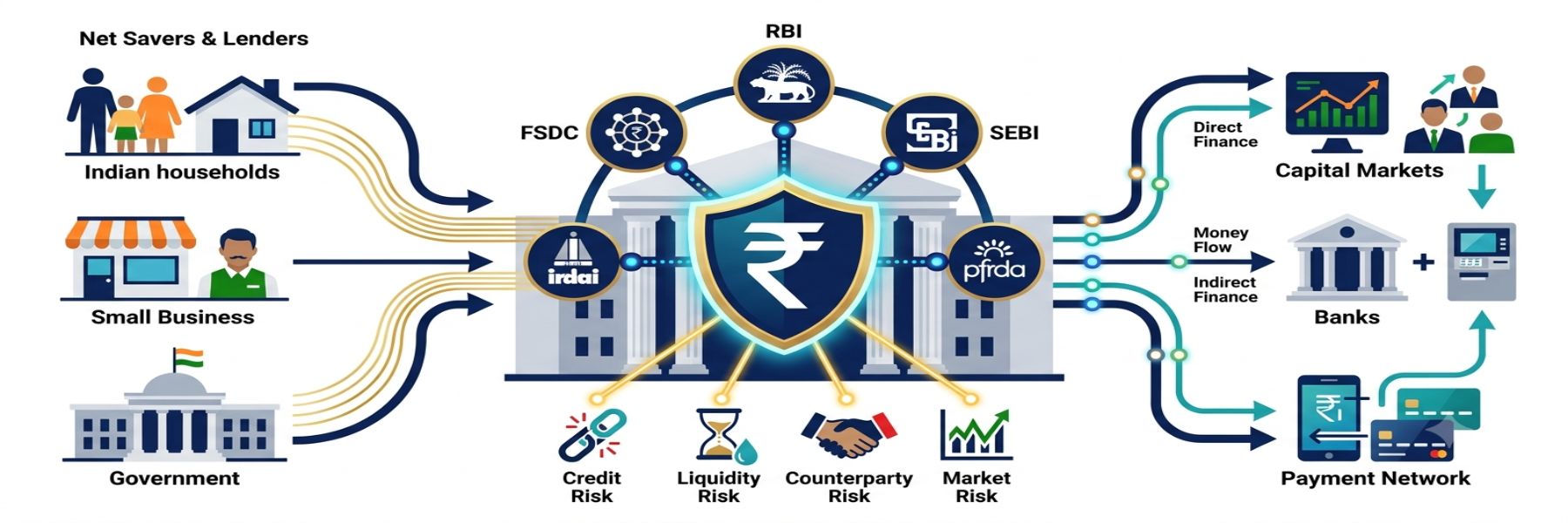
Structure of the Financial System
The financial system facilitates the connection between entities that have excess money and the ones that require finance. These individuals can be generally grouped into borrowers or net spenders and lenders or net savers. These may include governments, business enterprises, individual households, and foreign residents. Money moves in the financial system through two main channels.
Direct Finance :
The borrowers procure funds directly from the lenders using the financial market. The capital market and money market are the mechanisms through which the transfer of funds takes place from the fund-surplus to the fund-deficit entities.
Indirect Finance :
In this financial intermediaries act as intermediaries between lenders and borrowers. They mobilize the savings of surplus entities and allocate these savings to the borrowing entities.
Each of the channels is significant within the financial system. They enable the transfer of funds and ensure that resources are allocated efficiently to fulfill financial requirements.
Framework for Financial Stability
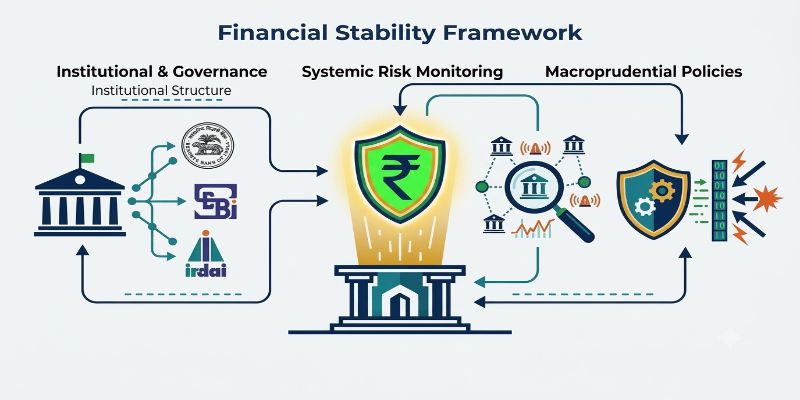
A financial stability framework consists of three broad elements.
Institutional and Governance Structure :
The organizational and governance framework is clearly defined and ensures that the financial authorities know their roles and work together to coordinate, In India, the various financial regulators and government bodies take care of different aspects of the financial sector such as financial institutions, markets and payment systems.
Measuring and Monitoring Systemic Risk :
Systemic risk is generated when problems within one financial institution, market, or sector spill over to others and disrupt the entire financial system. Assessment of systemic risk entails examining financial conditions, identifying weaknesses, and analyzing the reaction of institutions and markets to any negative shocks.
Implementing Macroprudential Policies :
Macro-prudential regulations focus on ensuring that there is stability within the financial system, dealing with risks inherent in it. Different from those that are institution-specific, macro-prudential regulations enhance the resilience of the overall financial system by tackling vulnerabilities that exist. This minimizes the possibility of the spread of risk in the financial system.
Financial Stability and Development Council
The Government of India created the FSDC in December 2010 at the apex level to enhance the structure of financial stability and coordination among financial sector regulators as well as the development of the financial sector. The chairman of the Council is the Union Finance Minister, while its core members are the Governor of RBI, the heads of SEBI, IRDAI and PFRDA, the Finance Secretary/Department of Economic Affairs Secretary, the Secretary of the Department of Financial Services, and the Chief Economic Adviser. Over time, the members of the Council have grown in number to include other relevant authorities.
The FSDC ensures coordination among the various bodies dealing with the various sections of India’s financial systems. This enables them to come up with mechanisms that will help detect any problems or risks that could be transferred across institutions in the financial system and other areas.
Financial Stability Unit of the RBI
The Reserve Bank of India (RBI) set up an independently functioning Financial Stability Unit (FSU) in August 2009 to enhance financial stability analysis and surveillance.
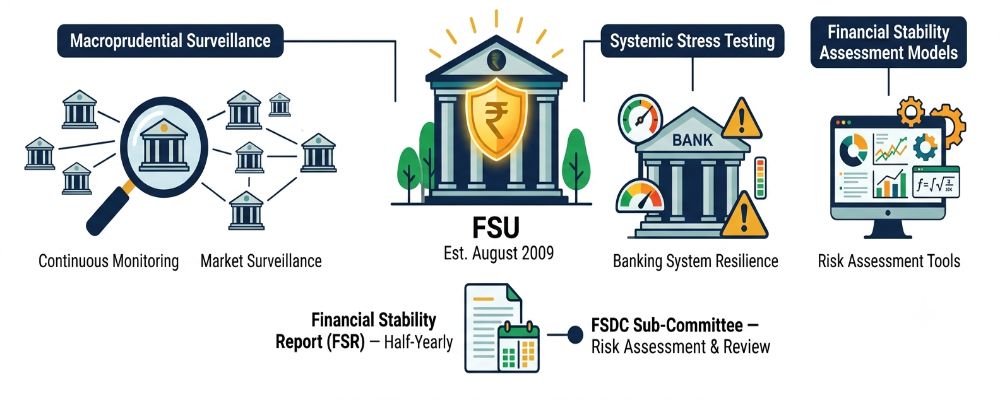
It prepares Financial Stability Reports (FSRs) on a half-yearly basis, which incorporate the joint assessment of the Sub-Committee of the Financial Stability and Development Council (FSDC) on the threats to financial stability in India.
Its primary responsibilities are as follows:
- Conducting continuous macroprudential surveillance of the financial system.
- Performing periodic systemic stress testing of the banking system.
- Development of financial stability assessment models.
While macroprudential surveillance helps in spotting vulnerabilities that can pose risks to the overall financial system, stress tests analyze the resilience of banks against any adverse conditions. The FSR incorporates risk assessments both in India and internationally, the resilience of financial institutions, and financial sector regulatory policies.
The Lender of Last Resort
Central banks are considered to be lenders of last resort because they provide liquidity to those financial institutions which are facing significant problems with their funding and are unable to secure enough financing in usual ways. This situation is especially relevant in case of financial panic or market stress since liquidity shortage may affect a number of institutions and hinder lending and other financial operations.
As a result, providing liquidity will assist the central bank to reduce the effects of financial crisis and prevent its further propagation. Nevertheless, it should be kept in mind that the problem of liquidity does not necessarily solve the problem of insolvency. Therefore, lender of last resort operation of central bank is quite essential.
Bagehot's Dictum
In 1873, Walter Bagehot, who was an editor of The Economist, released his book, entitled "Lombard Street," wherein he described some principles of how the central bank should act during financial crises. Such principles were later known as Bagehot's dictum and stated that during financial crisis, the central bank should give loans at a high rate of interest on good security.
The main objective of such approach is to provide liquidity to financial markets during their crises but not let any institution use emergency assistance under ordinary circumstances. Bagehot's dictum is still an important principle of central banking, especially concerning the role of the lender-of-last-resort.
RBI's Regulatory Role in Financial Markets
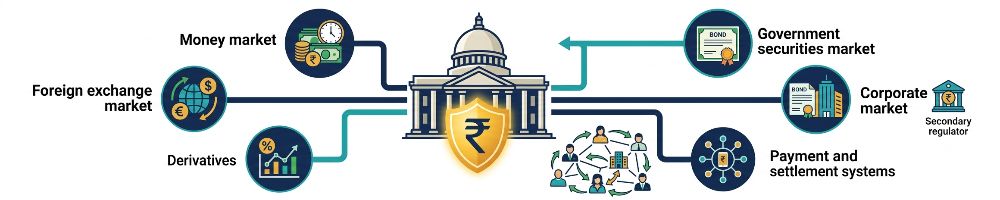
RBI controls various sectors of the Indian financial system.
1. Money market.
2. Government securities market.
3. Foreign exchange market.
4. Some sectors of the corporate debt market.
5. Interest rate, credit and foreign exchange derivatives.
6. Payment and settlement systems.
It controls differently depending on the sector, instrument, and the law. Other regulatory agencies like SEBI control certain sectors of the financial system. This makes coordination of efforts very important. Oversight of payment and settlement systems by RBI is part of its role in ensuring financial stability through efficient transfer of money from one person, business entity to another.
In Short
The stability of the financial system is necessary for its optimal operation and sustainable development of the Indian economy. The financial authorities in India, including the Reserve Bank of India, provide assistance in maintaining the stability by means of monitoring risks and applying both macroprudential policies and regulations and coordination among regulators. This goal is achieved with the help of institutions like the FSDC and the Financial Stability Unit of the Reserve Bank of India, as well as the lender of last resort mechanism.
Login with