
Prehistoric India – Stone Age: History, Periods, Tools & Important Facts
When considering Indian history, one usually learns about its great civilizations, kings, and empires. However, long before the rise of the Indus Valley Civilization, there existed people on the territory of modern-day India who obtained food, hunted, and made their first primitive tools. Such period is known as Prehistoric India, and since there was no written source at that time, the research of such period is carried out using findings like petroglyphs, tools, and other remnants left by the first inhabitants. Stone Age is traditionally considered as having three stages: Palaeolithic Age, Mesolithic Age, and Neolithic Age.
What was Prehistoric India?
Prehistory refers to the times in human history for which there is no documentation. Prehistory in India refers to the era being studied on the basis of findings made by archaeologists. Man had been living in the midst of nature; he was hunting, gathering food, living in caves and rocks. He made his first stone tools, mastered the art of making fire and adapting to the surroundings. There has been a very long history of the Stone Age that encompasses a huge period of time.
1. Palaeolithic Age – Old Stone Age
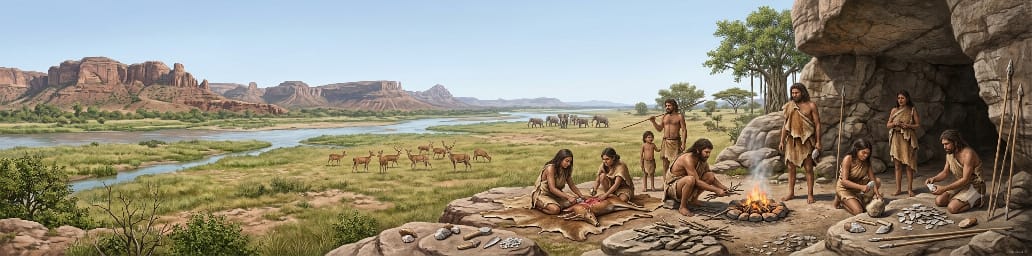
The Palaeolithic age means “old stone age”. This age marks the earliest cultural periodization. The food procurement of people was through hunting and gathering. They moved from one location to another in search of food. The primary source of food of these people was hunting and gathering. Stone was commonly used for the manufacturing of tools. Tools were crude and big at the beginning of this period. These people used to occupy caves, rock shelters and many other temporary structures. Human beings had knowledge about using fire for cooking, heat and protection. Hunting had an immense importance in the life of these people. They were nomadic or semi-nomadic.
Where Some of the oldest and most famous archaeological places in India include Bhimbetka, Soan Valley, Hunsgi Valley, Attirampakkam and Narmada Valley where traces of this era have been discovered. Bhimbetka in particular is famous for its rock-cut caves full of petroglyphes.
2. Mesolithic Age – Middle Stone Age
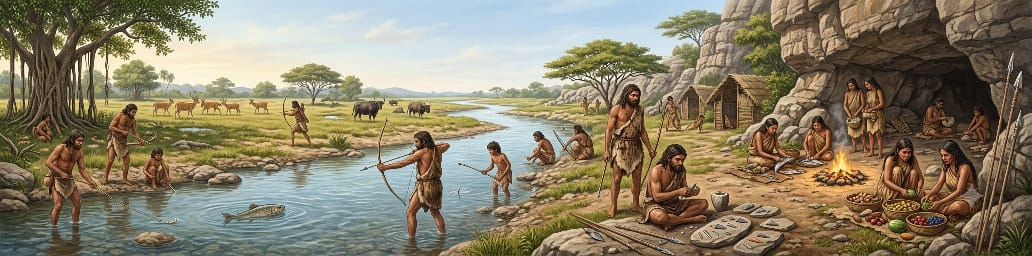
The Mesolithic Age or Middle Stone Age is the one which comes after the Palaeolithic Age but before the Neolithic Age. One of the characteristics of this era is the presence of Microliths, which are small stone tools used independently or in conjunction with weapons. The people still lived a hunter-gatherer lifestyle, though they started living in more organized communities. Small stone tools called microliths started appearing, Hunting and gathering were the two major sources of food just like the Paleolithic era, Fishing tools started being used, hence making fishing another source of food for people, Settled or Semi-settled life started becoming common, Rock paintings developed showing scenes of everyday life and hunting, Domestication of animals had already started by then in this broad transitional era. At the end of this era, there were signs of agriculture as well. Some of the most famous Mesolithic sites in India include Bagor, Langhnaj, Adamgarh, and Bhimbetka.
3. Neolithic Age – New Stone Age
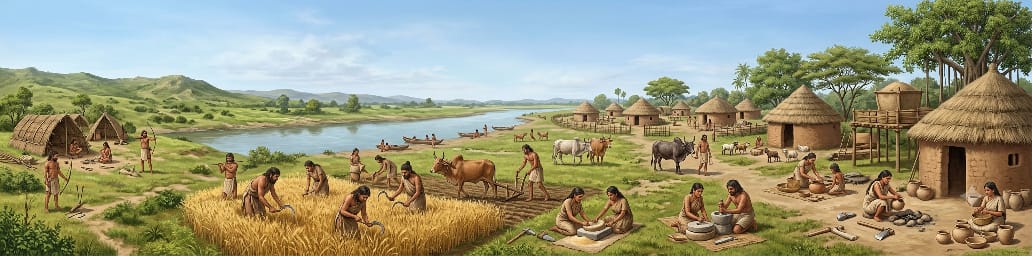
The Neolithic Age or New Stone Age is known for the change in the mode of living of humans from nomadic to a settled life. It is believed that the domestication of animals and agriculture began around 10,000 years ago in several places.Pottery was invented; more sophisticated stone tools were used, Domestic animals became a regular source of food,Agriculture was the major source of food, Animals were domesticated, Settlement or semisettlement of villages began, Tools made up of polished stones increased, Pottery was invented, Settled village life along with construction of houses took place,Spinning and weaving were practiced by certain tribes, Food production was more significant than hunting and gathering.
Stone Age Tools:
Overall, stone tools represent one of the most important components of the culture of the people who lived back then. The tools of various periods have certain features that help archaeologists date the tool to a certain period.
Tools of the Palaeolithic period: hand axes, cleavers, choppers, and scrapers.
Tools of the Mesolithic period: microliths, blades, points, and scrapers.
Tools of the Neolithic period: polished axes, celts, and adzes.
Rock Paintings of Prehistoric India:
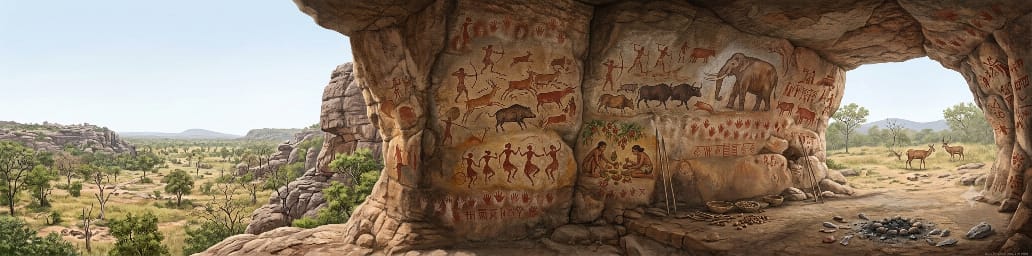
One of the most famous findings of the Prehistoric Era of India is the rock-cut caves of Bhimbetka found in the region of Madhya Pradesh. This place has many petroglyphs on the rocks. There are many figures carved on these rocks. They usually portray animals or life of humans including hunting and dancing. The paintings on rocks give us valuable information about the lives of people living in that era.
Hunting to Farming:
Among the key tendencies of the evolution of society during the prehistoric era was the transformation from the hunting economy to agriculture. Humans were able to control and utilize nature in order to provide food for an increasing number of people. Nevertheless, this process took considerable time and was not uniform: various groups of people used new technology at different stages of development.
Difference Between Palaeolithic, Mesolithic and Neolithic Ages:
| Feature: | Palaeolithic | Mesolithic | Neolithic |
|---|---|---|---|
| Also Known as | Old Stone Age | Middle Stone Age | New Stone Age |
| Agriculture | Not established | Began later | Well established |
| Tools | Rough stone tools | Small stone tools | Polished stone tools |
| Food | Hunting & gathering | Hunting & fishing | Farming & domestication |
| Lifestyle | Nomadic | Semi-settled | Settled |
Prehistoric India is the period of the early development of humankind. Indians were among the first to learn to make fire, control and use animals, and adopt agriculture.
In addition, they became the first ones to build the very first settlements. In such a way, the culture and life of the population inhabiting the lands of modern India play an extremely important role for the investigation of history.
Important Facts:
- Bhimbetka is situated in Madhya Pradesh.
- Bhimbetka is known for its pre-historic rock shelters and paintings.
- Burzahom is a famous Neolithic site in Kashmir.
- Agricultural practices became very significant during the Neolithic era.
- Animal domestication was one of the key aspects of the Neolithic era.
Knowledge of prehistory is very necessary for comprehending the history of ancient civilization of India. Furthermore, the knowledge of culture and life of people in prehistoric ages is of utmost importance while studying the history of mankind in general. Thus, it becomes very important to know about prehistoric age in India.
Login with