Mensuration Made Simple: Your Complete Guide from 2D Shapes to Advanced 3D Problems
Mensuration is simply the math of measuring. We measure area for flat 2D shapes and volume for 3D objects. Whether you're calculating how much paint a wall needs or how much water a tank can hold, mensuration is everywhere. This guide walks you through every concept from the basics to advanced problem-solving, with fresh examples so you can learn the patterns without memorising answers.
Part 1: 2D Mensuration – Flat Shapes
1.1 Triangles
A triangle has three sides, three vertices, and three angles. The angles always add up to 180°.
Classification by angles:
- Acute: all angles < 90°
- Right: one angle = 90°
- Obtuse: one angle > 90°
Classification by sides:
- Scalene: all sides unequal
- Isosceles: two sides equal
- Equilateral: all sides equal
Triangle inequality: The sum of any two sides must be greater than the third. For example, sides 2, 3, and 8 cannot form a triangle because 2 + 3 < 8.
Area Formulas
- Base–height:

- Heron’s formula:
 , where
- Sine formula:

Example (changed): Find the area of a triangle with sides 7 cm, 9 cm, and 12 cm.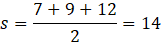

Special Triangles
- Equilateral: side

Height , Area
  , Perimeter
- Isosceles: equal sides , base

Height , Area
  , Perimeter
- Right isosceles: equal sides
Area , Hypotenuse
Congruency and Similarity
Two triangles are congruent if they are identical in shape and size. Criteria: SSS, SAS, ASA, AAS, RHS.
Similar triangles have the same shape but different sizes; their corresponding sides are proportional.
1.2 Quadrilaterals
A quadrilateral has four sides. A diagonal splits it into two triangles.
- Parallelogram: opposite sides parallel and equal.
Area , Perimeter
  . Diagonals bisect each other but are not equal.
 - Rectangle: parallelogram with 90° angles.
Area , Perimeter
  , Diagonal
  . Diagonals are equal.
 - Square: all sides equal, all angles 90°.
Area , Perimeter
  , Diagonal . Diagonals equal and bisect at 90°.
 - Rhombus: all sides equal.
Area , Perimeter . Diagonals bisect at 90° but are not equal.
 - Trapezium: one pair of opposite sides parallel.
Area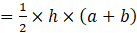
- Isosceles Trapezium: non-parallel sides equal; base angles equal.
1.3 Circles
- Centre: fixed point.
- Radius: distance from centre to circle.
- Diameter:
 .
. - Chord: line segment with endpoints on circle.
- Tangent: touches circle at one point.
- Arc: part of circumference.
- Sector: region between two radii and an arc.
- Segment: region between a chord and an arc.
Formulas:
- Circumference

- Area

- Arc length

- Sector area

- Semicircle: Perimeter
 , Area
- Quadrant (90° sector): Perimeter
 , Area
- Segment area

Angles in a circle:
- Angles in the same segment are equal.
- Major segment → acute angle; minor segment → obtuse angle.
- Cyclic quadrilateral: opposite angles sum to 180°.
1.4 Parallel Lines and Transversal
When a transversal cuts two parallel lines:
- Corresponding angles are equal.
- Alternate interior/exterior angles are equal.
- Co-interior angles sum to 180°.
- Vertically opposite angles are equal.
- Linear pair sums to 180°.
Part 2: 3D Mensuration – Solid Shapes
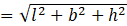
2.1 Cuboid
- Volume

- LSA

- TSA

- Diagonal
2.2 Cube
- Volume

- LSA

- TSA

- Diagonal

2.3 Cylinder
- Volume

- CSA

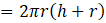
- TSA
2.4 Cone
- Volume

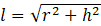
- Slant height
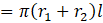
- CSA

- TSA

2.5 Frustum
- Volume

- Slant height

- CSA
- TSA

2.6 Sphere
- Volume

- Surface Area

2.7 Hemisphere
- Volume

- CSA

- TSA

2.8 Hollow Structures
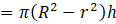
- Hollow cylinder: Volume
TSA
- Hollow hemisphere: Volume

TSA
Part 3: Miscellaneous and Advanced Concepts
3.1 Largest Shapes Inside Others
- Largest circle inside a square: side of square = diameter =

- Largest square inside a circle: diagonal of square = diameter = →

- Largest circle inside a rectangle: diameter = smaller side of rectangle
3.2 Path Area (Cross Roads)
For a rectangular field  with two cross roads of width
  :
:
Area of path 
3.3 Circumcircle and Incircle of a Triangle
- Circumradius

Equilateral:
Right triangle: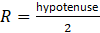
- Inradius

Equilateral:
Right triangle:
3.4 Fluid Flow
Volume flowing per second = cross-sectional area × speed
Rise in level = total volume ÷ base area of tank
Time = volume to be filled ÷ rate of flow
Remember: 1 litre = 1000 cm³, 1 m = 100 cm.
3.5 Melting and Recasting
Volume remains constant.
Number of small solids = volume of big solid ÷ volume of one small solid.
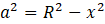
3.6 Cutting a Sphere
If a sphere of radius  is cut at distance
  from centre:
- Radius of circular cross-section:
- Extra surface area =

3.7 Successive Percentage Change
Net change = 
For volume , multiply individual multipliers.
Part 4: Worked Examples (Fresh Numbers, Same Concepts)
Example 1: Triangle Area (Heron’s Formula)
Find the area of a triangle with sides 7 cm, 9 cm, and 12 cm.

Example 2: Sphere and Rectangle
A sphere of radius 21 cm has the same surface area as a rectangle whose length and breadth are  cm and
  cm. Find .
Sphere SA 


Solving gives  cm.
cm.
Example 3: Cone and Cylinder Volumes
The volume of a cone is 50% more than the volume of a cylinder. The ratio of their radii (cone : cylinder) is 3 : 2. If the cone’s height is  cm, find the cylinder’s height.
Let cylinder radius = , cone radius =  .
.
Cone volume =  cylinder volume

 cm.
cm.
Example 4: Fluid Flow
A pipe of cross-section 10 cm × 25 cm carries water at 15 m/s. How high will water rise in a tank of base 30 m × 20 m in 90 minutes?
Area = 
Volume per second = 
Time =  s
s
Total volume = 
Tank base area = 
Height = 
Example 5: Hollow Garden Roller
A hollow garden roller is 50 cm wide with a girth of 352 cm. The iron thickness is 3 cm. Find the volume of iron used.
Girth =  →
→  cm
cm
Inner radius  cm
cm
Volume = 

Example 6: Cutting a Sphere
A sphere of radius 21 cm is cut at a distance from its centre. The total surface area of the pieces is  more than the original surface area. Find .
Original SA 
Extra SA 
Extra SA  →
→ 


Final Tips for Mensuration Problems
- Always identify whether the question asks for CSA, TSA, or Volume.
- For “gift wrap” or “curved”, use CSA. For “total surface”, use TSA.
- In melting/recasting, equate volumes.
- For percentage change, use multipliers (e.g., +20% → ×1.2, −15% → ×0.85).
- Keep units consistent — convert cm to m when needed.
- Memorise the standard formulas; they are the building blocks.
Mensuration may seem like a lot of formulas, but once you understand where they come from and how they connect, it becomes a logical puzzle. Practice with different numbers, and you’ll be ready for any problem that comes your way.
Login with