
Broad Structure of the Indian Banking System
India’s banking system is broadly divided into different categories based on their role and the needs they address. Some of these are Commercial Banks, Cooperative Banks, Regional Rural Banks, Small Finance Banks, and Payments Banks.

Commercial Banks
The foreign banks and the local area banks are also components of the Indian banking system. The banking system also interacts closely with the development financial institutions and other financial institutions. The commercial banks collect deposits from the public and also make loans.This banks can be categorized into public sector banks, private sector banks and foreign banks. main functions of the commercial banks include accepting deposits, lending, payments etc.
Public Sector Banks
Public Sector Banks refer to those banks that have a majority share of ownership by the government.
The following list of Public Sector Banks in India as per the year 2026 is as follows:
1. Bank of Baroda
2. Bank of India
3. Bank of Maharashtra
4. Canara Bank
5. Central Bank of India
6. Indian Bank
7. Indian Overseas Bank
8. Punjab & Sind Bank
9. Punjab National Bank
10. State Bank of India
11. UCO Bank
12. Union Bank of India
This is the present list according to the Department of Financial Services, Ministry of Finance, Government of India.
Major Public Sector Bank Mergers
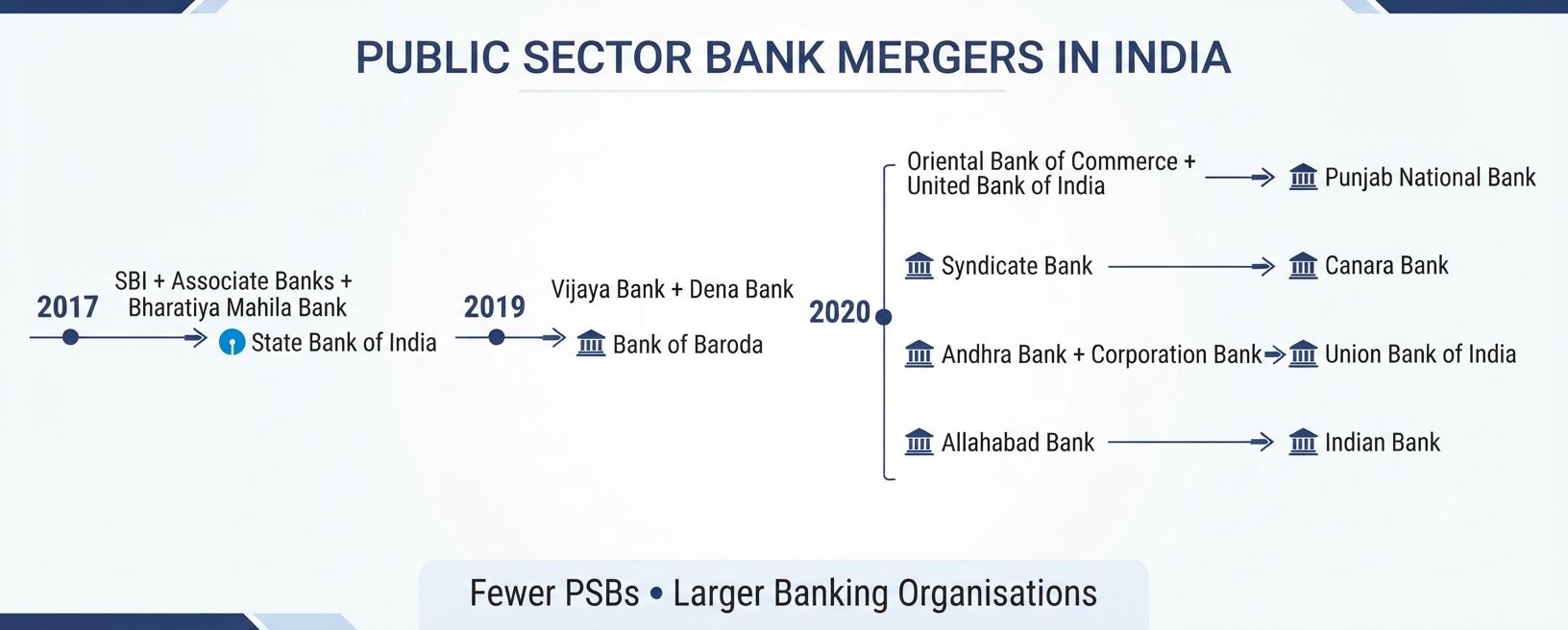
Various public sector banks have been merged with each other in different phases. State Bank of India got merged with its associate banks and Bharatiya Mahila Bank in 2017. Vijaya Bank and Dena Bank got merged with Bank of Baroda in 2019. Punjab National Bank absorbed Oriental Bank of Commerce and United Bank of India in 2020. Canara Bank absorbed Syndicate Bank in 2020. Union Bank of India absorbed Andhra Bank and Corporation Bank in 2020. Indian Bank absorbed Allahabad Bank in 2020. This merging of banks has led to reduction in number of Public Sector Banks and also resulted in the formation of large Banking organizations.
Private Sector Banks
Private sector banks are those banks whose ownership is held by private shareholders. Examples of such banks are:
HDFC Bank
ICICI Bank
Axis Bank
Kotak Mahindra Bank
IndusInd Bank
Federal Bank
YES Bank
IDFC FIRST Bank
Note : The private sector banks also work within the guidelines of RBI.
Foreign Banks
Foreign banks are those banks which are established outside India but have branches or other forms of operations in India. These banks offer services to their corporate, individual, and overseas clients. Their operations in India are supervised by the RBI.
Cooperative Banks
This banks operate on cooperative principles. There are Urban Cooperative Banks, State Cooperative Banks and District Central Cooperative Banks. There is another category called PACS (Primary Agricultural Credit Societies) under the rural credit cooperatives.
Cooperative banks offer banking services to individuals, firms, farmers and cooperative members, according to the type of structure. activities of this banks are regulated and supervised by the Reserve Bank of India in regard to their banking operations, and other cooperative functions are governed by appropriate government authorities at the Central/State level.
Regional Rural Banks
Regional Rural Banks are institutions set up with a view to develop institutional credit in rural areas.These banks mainly focus upon the needs of agriculture, small and marginal farmers, rural artisans, small businesses, rural households and financial inclusion. Rural banks combine the features of commercial banking with that of rural development and agricultural progress. They make a significant part of the Indian rural banking system.
Small Finance Banks
Purpose behind Small Finance Banks They were established to facilitate financial inclusion. Small Finance Banks concentrate on delivering banking facilities to disadvantaged sections of society, such as small and marginal farmers, micro and small industries, unorganized sector borrowing units and economically weaker sections. The RBI released the final licensing guidelines for Small Finance Banks in November 2014.
Payments Banks
Payments Banks have been introduced to take care of basic banking and payment needs. They can accept deposits up to the limits stipulated by the regulatory authorities, but cannot undertake lending activities .Their focus would be on small value deposits and payments, remittances and digital transactions. The guidelines issued by RBI for licensing of Payments Banks in November 2014.
Local Area Banks
These banks were established to offer services in a given geographical region. The objective of these banks is to mobilize savings and the credit funds are advanced to local businesses, farmers and other activities.
Local Area Banks are smaller in their approach as compared to the commercial banks and focus on the needs of the people in the local areas they serve. These banks constitute a small percentage of the Indian Banking system.
Scheduled and Non-Scheduled Banks
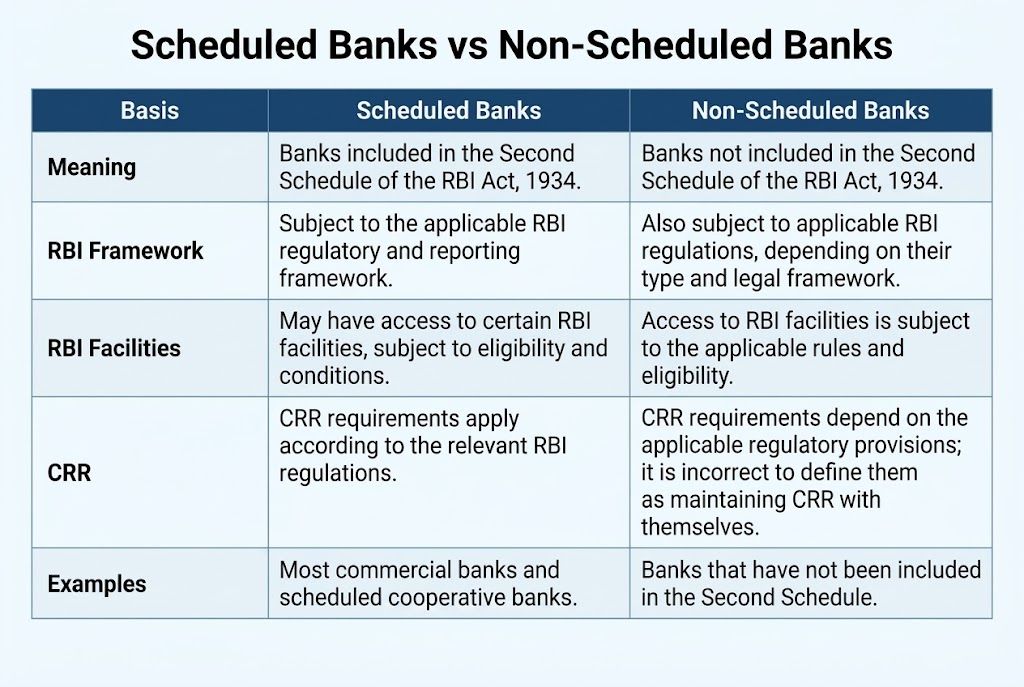
A scheduled bank is a bank included in the Second Schedule to the Reserve Bank of India Act, 1934. These are those banks that meet the requirements set forth in the RBI Act for inclusion in the Second Schedule. Scheduled commercial banks include public-sector banks, private-sector banks, foreign banks, Regional Rural Banks, Small Finance Banks and other eligible banks. The word “scheduled” indicates a bank that has been added to the Second Schedule of the RBI Act and does not imply that the bank is owned by the government.
Note : a private-sector bank can also be a scheduled bank
Development Financial Institutions
Development Financial Institutions were formed for the purpose of providing long-term financing and supporting particular economic sectors.
Some important Development Financial Institutions are:
NABARD – agriculture and rural development
SIDBI – micro, small and medium enterprises
EXIM Bank – international trade financing
NHB – housing finance sector development
NaBFID – infrastructure financing
Note : EXIM Bank, NABARD, NHB, SIDBI, and NaBFID are regarded as All-India Financial Institutions.
Types of Deposites in India

Demand Deposits
Demand deposits are deposits which are normally withdrawable on demand, depending on the nature of the respective account. The most common types are savings and current deposits.
Current Account :
A current account, normally is a transaction account, which is used mainly by businesses and traders, company, entrepreneurs, institutions, and other entities which need to make frequent payments and receipts. Normally such accounts provide more flexibility in transactions. No interest is typically paid on current account balances, although this may depend on the bank and product. Overdrafts may also be available subject to the customer's eligibility and the bank's terms.
Savings Account :
The purpose of a savings account is basically that of keeping the money safe while earning interest from it. Various facilities like ATMs/debit card facility, net-banking, mobile-banking, UPI link, standing instructions facility, bill payments facility, and sweep facility can be available in savings accounts depending upon the nature of the product. It entirely depends upon the banks and the specific nature of the savings account whether the various facilities are available or not.
Term Deposits
A term deposit is a deposit held by a bank for a certain period of time, usually paying interest. The two types of term deposits are Fixed deposits and Recurring deposits.
Fixed Deposit :
According to this type of deposit under which the client opens an account by making a deposit with a bank. The bank then pays him interest based on the contract. Upon maturity of the account, the customer receives the amount he deposited plus the interest. However, it may be possible for the client to withdraw funds before the expiry date, but this will entitle him to penalties as specified in the contract.
Recurring Deposit :
In a recurring deposit, the customer makes a deposit of a certain amount periodically, usually monthly for a definite period of time. It is beneficial for those who desire to save some amount on regular interval basis rather than depositing a lump sum amount at one time.
Types of Bank Accounts
Non-Resident Accounts
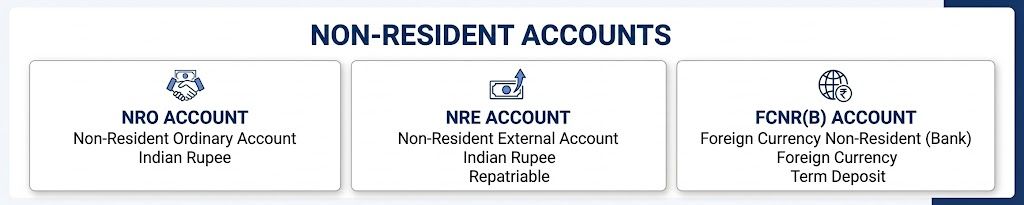
NRIs can open various kinds of bank accounts in India according to foreign exchange rules. The main types are NRO Account, NRE Account and FCNR(B) Account.
NRO Account :
NRO means Non-Resident Ordinary Account. It is usually held in Indian currency and can be used to manage income generated in India, including rent and pension and other eligible income from India. The interest on NRO account is taxable in India according to applicable rules. The eligible amount may be repatriated as per applicable rules of FEMA and RBI.
NRE Account :
This account means Non-Resident External Account. The NRE account is held in Indian rupee currency and is primarily used to hold funds transferred from abroad and any other source allowed. The funds deposited in an NRE account along with the interest accrued thereon can be remitted provided that certain conditions are met. Interest on the NRE account is not taxable in India.
FCNR(B) Account :
FCNR (B) means Foreign Currency Non-Resident (Bank) Account. This type of account is different from the other two accounts in the sense that the deposit in this case is in permissible foreign currencies. FCNR(B) is basically a term deposit where the eligible NRIs have the flexibility to keep their deposit in foreign currency.
Banking accounts that operate internationally are bank accounts that banks use for the purpose of conducting transactions with other foreign banks and for international payments. They include Nostro, Vostro and Loro accounts. In addition, a Mirror Account is an account kept internally by the bank for correspondence with a Nostro account.

Nostro Account :
"Nostro" means “our account with you”. This Account refers to the account which is held by the domestic bank with the foreign bank in the currency of the foreign nation. For eg, the Indian bank will keep its US dollar account with the bank of the US.
Vostro Account :
“Vostro” means “your account with us.” Vostro account refers to an arrangement wherein a foreign bank maintains an account with a domestic bank. For example, a foreign bank may maintain an account with an Indian bank for the purpose of allowing transactions in India.
Loro Account :
The word "loro" means "their account with them." A Loro account is a term used by one bank in connection with the account between two other banks.Example: Suppose Bank A refers to an account maintained by Bank B with Bank C.
Mirror Account :
A mirror account is an internal record maintained by a bank to correspond with its Nostro account. It helps the bank reconcile the transactions recorded in its own books with those reflected in the foreign bank account.
For examination purposes:
Nostro = Our account with you
Vostro = Your account with us
Loro = Their account with them.
In Short :
The banking system in India includes various kinds of banks and financial institutions, which play an important role in facilitating saving, lending, payments, financial inclusion, and economic development. There are different kinds of commercial, cooperative, development, deposit, and banking accounts that are served for distinct purposes in the financial system.
Login with