
What is Employment?
Employment is when one is involved in an economic activity in the production of goods and services with direct or indirect payment or any other economic gain. it has different types include wage employment, salaried employment, self-employment, casual employment, agricultural employment, non-agricultural employment, formal employment and informal employment.
Employment contributes positively to consumption, standards of living, income, skill development, productivity, economic growth and reduction of poverty. But employment does not necessarily result in some employment gains like high income, good working conditions and job security among others. A more holistic approach to analyzing the state of employment should look into the different elements of employment.
Labour Market
it is defined as the interaction between individuals supplying labor for economic purposes and the opportunities for employment.
One of the simple frameworks for the working age population would be:
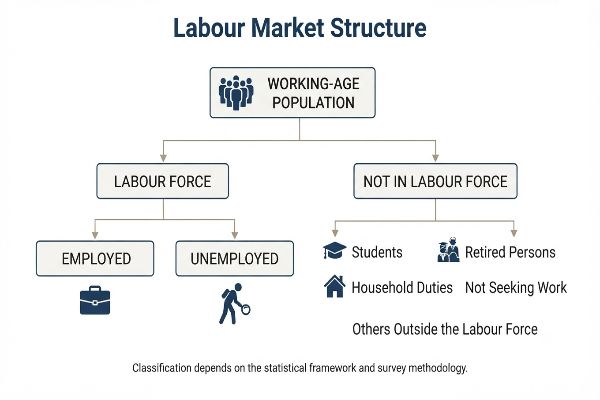
Labor Force is made up of individuals who are either employed or unemployed (based on the statistical definition). Individuals who are unemployed are generally individuals who do not have any jobs but are actively looking for or are available for work.
Those who are not part of the labor force would be those who are neither employed nor unemployed. They include students, retired individuals, individuals who are performing household chores, individuals who are not seeking employment, and other individuals who are not participating in the labor market. It is to be noted that the categorization is based on statistical definitions, and not because they are incapable of participating in the workforce.
Working-Age Population
Working-age population means the population within the age which is being used for labour market statistics. There is no single definition which is followed by all the statistical systems. According to the Periodic Labour Force Survey of India, many key labour market figures are provided for persons 15 years and above
Thus, an article on employment in India shall not define only 15-64 years as working age.
Labour Force
The labour force consists of people who are employed, or an unemployed but are seeking and/or available for work in accordance with the relevant statistical classification. The labour force does not include all the people in the population.
For instance, a student who is neither seeking nor available for work is usually considered to be out of the labour force under the relevant statistical classification.
Dependency Ratio
The concept of the dependency ratio seeks to capture the share of the population that is dependent economically and those who are capable of providing for them.
The popular formula for the dependency ratio is given below:
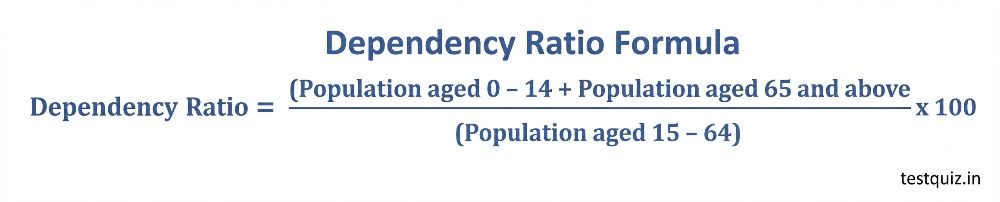
A higher dependency ratio suggests that the economically productive population has to cater to a much larger number of economically dependent individuals than required.
Demographic Dividend
Demographic dividend means the potential economic growth that may occur when there is a change in the age structure of a population. The term generally refers to a situation where the proportion of working age population is higher than the non-working age population. However, a demographic dividend is not an automatic gain. In order to realise the demographic dividend, the following factors must be present
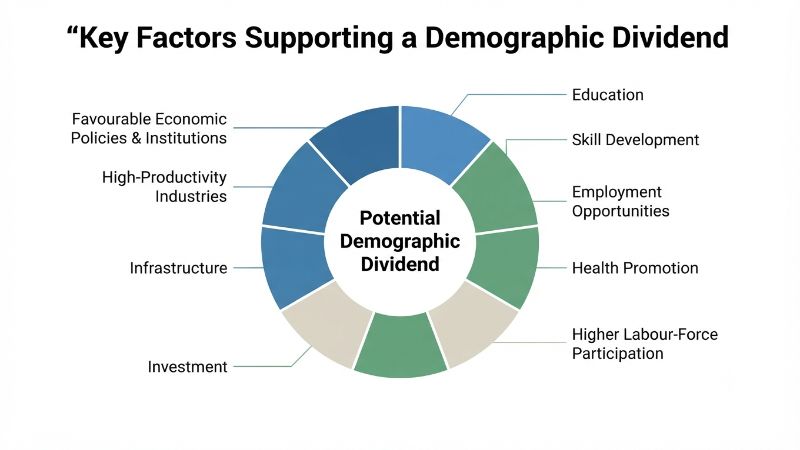
Note : Young population + skills + employment + productivity = potential demographic dividend.
Unemployment
Unemployment is defined as a condition whereby individuals who lack jobs and are looking for jobs as well as available for employment are termed as unemployed according to a certain statistical definition. It varies according to the kind of statistical method being utilized.
The unemployment rate can be calculated by using the formula below:
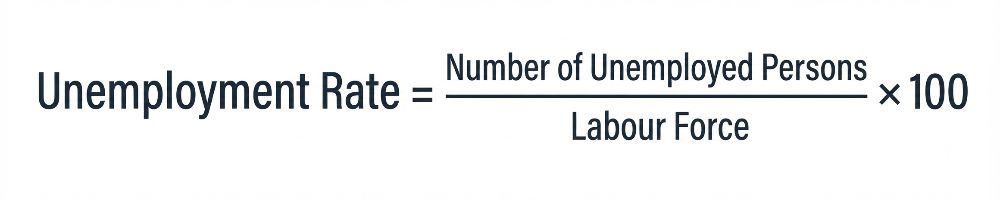
Where in the denominator is the labor force and not the total number of population.
Example:
Labour force = 1,000
Unemployed = 50
Unemployment rate:
(50/1,000) x 100 = 5%
Latest Unemployment Data in India
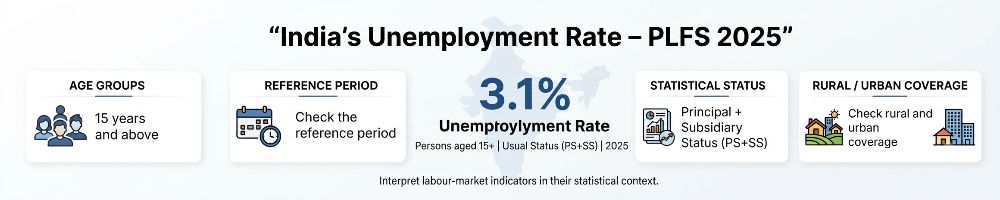
India's labour-market statistics are generated by the Periodic Labour Force Survey (PLFS), conducted by the Ministry of Statistics and Programme Implementation (MoSPI). For the PLFS 2025 Annual Report, the labour-market indicators have been presented using an array of statistical methods, age groups.
The all-India unemployment rate (Principal Status+Subsidiary Status) for persons aged 15 years and above was 3.1% in 2025 .
The figure should be considered in context of the following:
1. Age groups
2. Reference period
3. Statistical status
4. Rural/urban coverage
Types and Forms of Unemployment
Open Unemployment
Open unemployment refers to instances where people are ready and able to work, but are unable to get a job. This type of unemployment is easy to spot since the individual does not have a job.
Structural Unemployment
Structural unemployment takes place when the skills of the workers do not match those required by employers It may be caused by technological changes, changes in industries, changes in consumer demand, new methods of production, and skill mismatches.
For eg, old skills may make it hard for people to get jobs in industries that demand new skills.
Frictional Unemployment
This type of unemployment occurs when people are unemployed temporarily due to the fact that they are looking for new jobs, moving from one job to another, entering the labor market or changing occupations.
This kind of unemployment has a direct link with the phenomenon of job searching.
Cyclical Unemployment
Cyclical unemployment is associated with fluctuations in economic activity. In case there is an economic recession or a slowdown in the economy, demand will fall, production will fall, firms will lay off workers, and individuals will become unemployed. As the economy improves, the rate of cyclical unemployment falls.
Underemployment
Underemployment arises when persons are employed but their labor is not fully utilized. They may be working less than they like, working at a lower skill level than they possess, working at lower productivity, or not getting enough work even though they are willing to work more.it concerns the quality of employment and the degree of utilization of labor. It must not be confused with unemployment.
Disguised Unemployment
Disguised unemployment takes place when more people are engaged in an activity than required for that level of production. It is mostly related to agriculture and family work. in this If some number of workers get removed from the process and the level of production almost remains the same, then the removed worker from that process is said to be disguised unemployment.
Seasonal Unemployment
Seasonal unemployment occurs due to the fact that there are jobs in certain times of the year only. The example of it can be agriculture, tourism, some construction businesses, etc. People can find themselves unemployed in the off-season periods.
Casual Unemployment
Casual employment is used to describe workers who get irregular or temporary work. These workers are not always employed and They may be laid off. Examples of casual employment include casual labor, daily-wages jobs, seasonal agricultural work, and short-term service jobs.
Note : casual unemployment differs from casual employment.
Chronic Unemployment
Unemployment for an extended period of time is defined as chronic unemployment. it can be attributed to factors like slow economic growth, lack of employment opportunities, skills mismatch, structural problems, and labor disequilibrium.
Natural Rate of Unemployment
It is the unemployment rate under normal conditions in the labour market, with no cyclical unemployment. It is associated mainly with frictional and structural unemployment. Some workers may be in transition between jobs, searching for work, or at the cutting edge of technological change, or simply have skills and qualifications that are not in demand. Therefore, there is no zero unemployment that can be taken as a given.
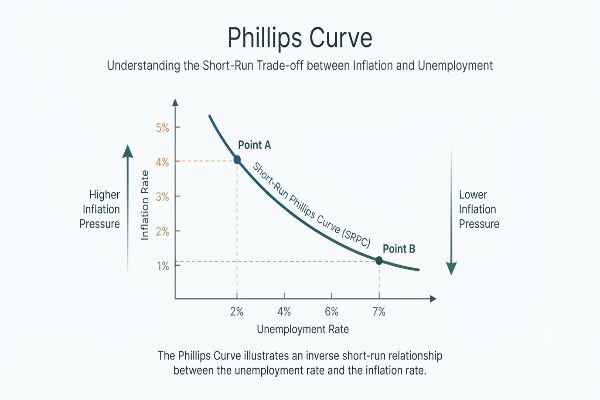
Phillips Curve : (unemployment Vs Inflation)
The first analysis of the relationship between unemployment and wage inflation was done by A. W. Phillips for the United Kingdom. The classical short-run Phillips curve shows that there is a negative correlation between inflation and unemployment when particular conditions exist. In other words, there exists a relationship between unemployment and the rate of inflation. But, in the long run, unemployment cannot have any negative effect on inflation. So, there is only a short-run trade-off between inflation and unemployment. Stagflation, which emerged in the 1970s, created problems for the Phillips curve theory.
Thus, in current macroeconomics, there is the study of both short-run Phillips curve and long-run Phillips curve.
Causes of Unemployment in India
Unemployment Causes in India are the reasons which can cause unemployment, that is, where people who are capable and willing to work do not have any job opportunities available for them.
Skill and Education Gaps
Mismatch of workers’ skills and employers’ needs may lead to the problem of getting an appropriate job. It may be caused by the insufficient level of vocational training, skill mismatch, technologization, and the absence of industry-oriented education.
Labour Supply
If the size of the labor force increases at a faster pace than the creation of productive employment opportunities, then both unemployment and underemployment may rise. Population growth does not necessarily result in unemployment. What really matters is whether enough productive employment opportunities have been created.
Dependence on Agriculture
Agriculture still is a major sector that provides jobs in India. Agricultural employment may consist of seasonal employment, disguised unemployment, underemployment, poor productivity, and dependence on rains and farming conditions.
Structural Changes
Changes in technology, industrial composition, consumer tastes and production processes may give rise to demand for certain skills while lowering the demand for some other skills. It can result in structural unemployment.
Inadequate Job Creation
Economic development doesn’t guarantee creation of adequate jobs for all new participants in the labour market. Creation of jobs is dependent on the type of economic development, industrial structure, labour demand, productivity, investment and business environment.
Informal Employment and Job Quality
An individual could have a job yet he/she may still be experiencing low earnings, unstable work situation, limited social security, bad working conditions, and inadequate working hours. For this reason, an employment analysis needs to look beyond unemployment rate.
Unemployment Measured in India
Statistics on India’s labour force are derived from the Periodic Labour Force Survey carried out by the National Statistical Office within the Ministry of Statistics and Programme Implementation.
The key methodologies are follow :
Usual Status
The method of usual status applies a longer reference period, commonly the previous 365 days. It assesses the primary and secondary economic activity of an individual during this period. It is applicable to comprehend long-term employment situation.
Current Weekly Status
According to Current Weekly Status method, the reference period is the previous week. The behavior of the individual during that week is taken into account while classifying him/her. It is helpful when labor market conditions are to be analyzed for a shorter period.
Current Daily Status
The Current Daily Status method, activity is measured on a daily basis during the reference week. This is beneficial because the employment/unemployment status can vary on different days of the week. This could be helpful in measuring intermittent or irregular employment.
Employment and Poverty
Poverty and employment are correlated with each other, but they are not the same thing. Employment can contribute to the rise of poverty due to reduced family income, reduction in consumption, reduced savings, debt accumulation, and lack of access to education and medical facilities. But employment does not necessarily mean the absence of poverty. A person can be engaged in employment activity, yet be poor due to various factors such as low wages, lack of working hours, family size, productivity, being employed in the informal sector, and high costs of living.
Employment Generation and Poverty Reduction
Job creation is one of the key ways in which economic growth can have an effect on poverty reduction. Job creation can enhance the incomes of households, improve their consumption levels, skill development, economic independence, access to education and health services, financial inclusion, and build household resilience.
At the same time, the nature of the employment matters as well. One can be employed and yet have low pay, poor working hours, absence of social security, unsafe working conditions, low productivity, and even absence of assured incomes. This means that job creation must take into account both numbers and productive employment.
Note :
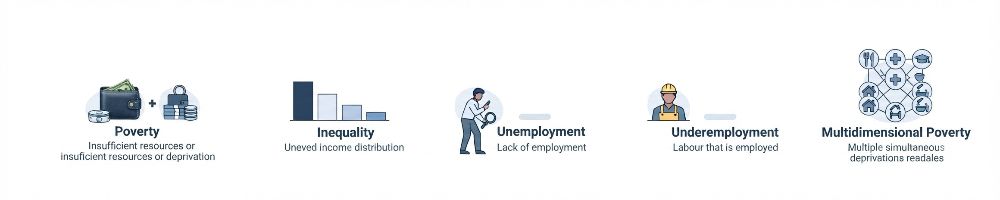
Employment is one of the key factors for economic development and reduction of poverty. The expanding economy requires adequate employment opportunities so that new labour-market entrants could be absorbed. Unemployment, however, cannot be considered separately from other types. Unemployment may be structural, frictional, seasonal, disguised and underemployment.
The demographics of India provide a significant opportunity in the form of a demographic dividend. This opportunity, however, can be utilized only if people have the access to education, skills, healthcare and employment.
Login with