
Banking Reforms
The banking sector was already faced with various challenges before the introduction of reforms in the financial sector during the 1990s. Banks were making low profits, they were dealing with too many non-performing assets, they had poor capitalization, there were problems of directed credits, lack of transparency, inefficiency, low competition and banking supervision among others. These challenges showed that major changes were needed within the banking system. Therefore, the Government of India decided to constitute the Committee on the Financial System in August 1991, which was headed by M. Narasimham. The Committee was responsible for reviewing the structure and operations of the financial system and recommending reforms.
These recommendations provided an important platform for the future banking reforms in the country. The reform program attempted to enhance the efficiency and financial strength of banks through prudential norms, transparency and supervision, competition and operational flexibility of banks among others.
Narasimham Committee I — 1991
The first Narasimham Committee was set up in August 1991 under the Chairmanship of M. Narasimham. The Committee was also known as the Committee on the Financial System. The suggestions made by this committee had a significant influence on the reforms carried out in India in the banking and financial sectors during the 1990s.
g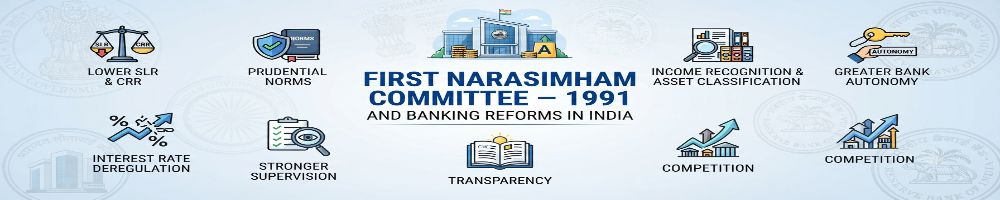
The major suggestions of the committee included reducing the statutory pre-emption of banking resources through lowering of SLR and CRR; introducing prudential norms, capital adequacy standards, income recognition, and objective provisions for bad and doubtful assets; and allowing more operational flexibility to banks.
The other suggestions included deregulating interest rates; better transparency; supervising of the banking sector more efficiently; and encouraging competition in the banking sector through greater involvement of the private sector.
The other suggestions of the committee were about restructuring and development of the banking system.
Capital Adequacy
Capital adequacy is about the ability of a bank to keep adequate capital considering the risks attached to their assets or exposures. Capital is a financial pillow that allows banks to offset unexpected losses. The capital adequacy rules in India have changed over the years, and include international regulatory standards, including Basel. In 1992, the Reserve Bank of India came up with a risk-based capital adequacy rule for the banks, adopting the Basel framework.
This means that the previous PDF document, which talks about the Narasimham Committee “reaching 8% capital adequacy ratio,” needs to be interpreted from a historical perspective. The 8% number relates to Basel I capital rules, and its adoption in India; it is not the entire or current capital rule.
Prudential Norms
Prudential regulation is a mechanism that ensures the financial soundness and risk management of banks. The key areas of prudential regulation are capital adequacy, income recognition, asset classification, provisions, exposures, risk management, disclosure, and corporate governance.
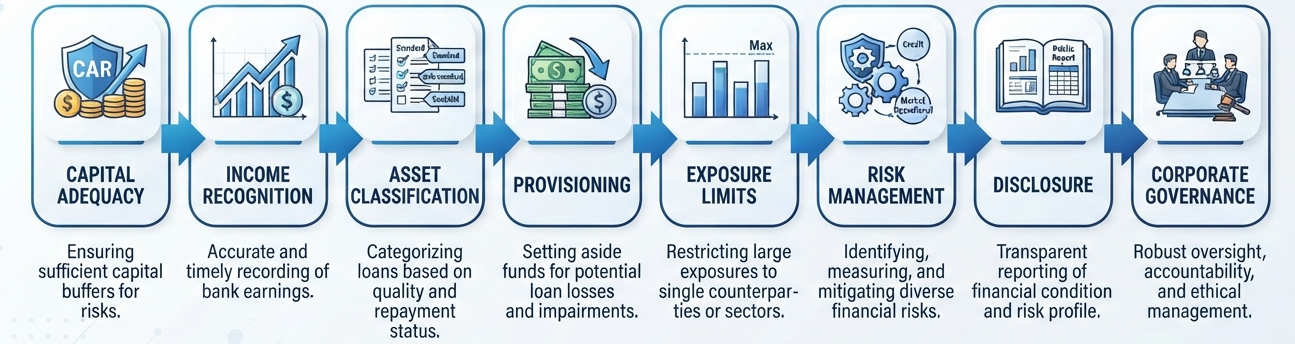
These regulation areas are extremely significant for the banking system as they allow banks to assess and control their risks and protect their financial interests, increase their transparency, improve the banking system’s stability, and ensure the banks’ profitability.
Non-Performing Assets
Non-Performing Assets (NPAs) refer to any loan or advance whose performance ceases to yield any returns for the bank as per the relevant classification regulations. In most cases, term loans qualify as NPAs when the interest and/ or installment payments of the principal amount become overdue for 90 days and above.
Large NPAs lead to lower profit margins and higher provisioning and may lower the quality of the balance sheet of banks. Banks hence were reformed to pay more attention to classification of stressed assets, adequate provisioning, asset reconstruction, recovery methods, capital restructuring, and risk management.
Narasimham Committee II — 1998
The second Narasimham committee was formed in 1998 under the chairmanship of M. Narasimham and was known as the Committee on Banking Sector Reforms. The objective of the committee was to examine the progress of reforms within the banking sector and recommend ways in which the banking sector could be strengthened.
Some of the main recommendations made by the committee include measures for strengthening the banking system, increasing capital adequacy, decreasing non-performing assets, improvement in prudential norms, better bank governance, increased operational autonomy to the banks, and examination of the share of government in the banks.
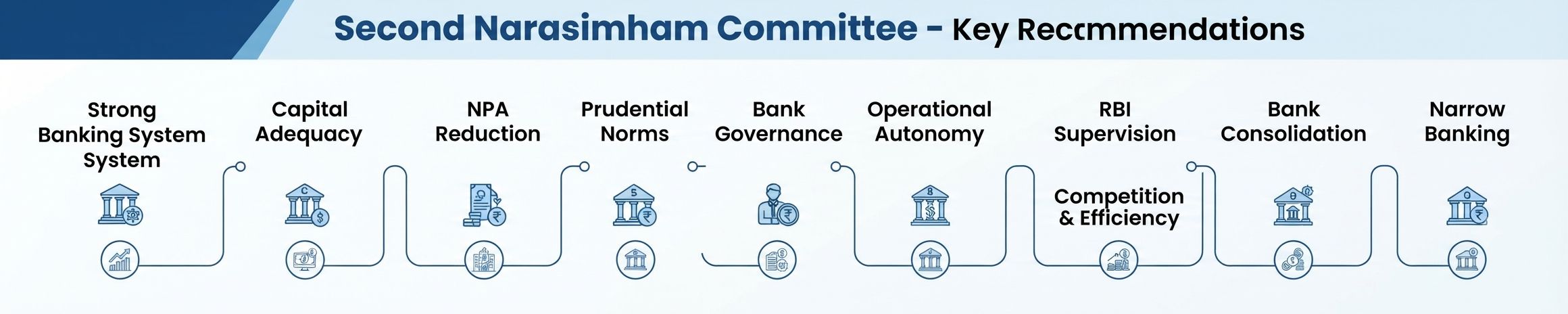
The committee also recommended the strengthening of banking supervision and the regulatory functions of Reserve Bank of India, along with increasing competition and efficiency within the banking sector. The committee also suggested the consolidation of banks and the concept of narrow banking. The recommendations of the Narasimham committees - II have been very significant in determining the reforms in the Indian banking sector.
Narrow Banking
The theory of narrow banking was developed in connection with weak banks experiencing financial problems. It is because the weak banks would be able to keep the greater portion of their assets in relatively short-term and liquid form until the time their finances are sorted out. The theory is most often applied to weak banks of the public sector with high Non-Performing Assets (NPAs).
Asset Reconstruction
Asset reconstruction mechanisms were conceived to tackle the stressed and non-performing assets in the banking system. The Second Narasimham Committee in 1998 recommended the creation of Asset Reconstruction Companies to address the issue of problem assets in the banks and to help them in cleaning their balance sheets.
The Union Budget 1998–99 gave the idea of setting up of ARCs by the banks with high NPA on an experimental basis, and SARFAESI Act, 2002 gave the legal framework for the creation of Asset Reconstruction Companies in India. Thus, the present ARC framework finds its roots in the recommendations made by the Narasimham Committee Report, particularly the Second Narasimham Committee Report.
Mission Indradhanush
The Mission Indradhanush reform initiative was initiated in 2015, aimed at the PSBs. Mission Indradhanush comprised multiple components that pertained to recruitment, capitalization, governance, accountability, empowerment, and efficiency of operations within PSBs. As the Mission Indradhanush falls into the category of reforms which are outdated due to their relevance to an earlier phase of banking sector reforms, it is essential to consider this reform as a historical reform initiative.
Stressed Assets & Financial Inclusion
SARFAESI Act, 2002
Securitisation and Reconstruction of Financial Assets and Enforcement of Security Interest Act, 2002 (SARFAESI Act) was enacted to make the process of recovery of secured loans more stringent and effective. It provided for the enforcement of security interest without prior court or tribunal proceedings in certain situations as per the provisions of the Act by qualified secured creditors. This Act played an important role in India’s stressed asset resolution and loan recovery framework.
Four Rs Approach
In later periods, the government and regulators considered four key areas for handling stressed bank assets: Recognition, Recapitalisation, Resolution and Reform. The aim was proper recognition of stressed assets, improving the capital base of banks, resolving bad debts and improving the operations of the entire banking system.
The Four Rs concept has been primarily linked to the banking reform measures taken during the 2015-16 period. Thus, it should not be presented as the entire structure of the banking system in its current state.
Financial Inclusion
Financial inclusion can be defined as ensuring that people and institutions have access to beneficial financial services at affordable costs, especially those that are disadvantaged and vulnerable. Key areas include bank accounts, savings, loans, insurance, pensions, payments, remittances, and digital financial services. Banking agents and technology have been instrumental in increasing the accessibility of formal financial services to those disadvantaged sections of society.
Jan Dhan, Aadhaar and Mobile — JAM
The term “JAM” indicates the amalgamation of Jan Dhan, Aadhaar, and Mobile. This integration of all three contributed to financial inclusion, as well as making it possible for DBTs (Direct Benefit Transfers). It became a significant factor in the context of India’s financial inclusion and digital infrastructure development.
Some More In short :
PMJDY (Pradhan Mantri Jan-Dhan Yojana) contributed in connecting individuals who did not have easy access to banks with bank accounts and services.
AePS (Aadhaar Enabled Payment System) contributed in reaching basic banking services to the people using the system of Business Correspondents and micro-ATM machines.
UPI (Unified Payments Interface) facilitated instant payments using mobile phones, thus helping to increase the reach of digital finance services among individual users and small business owners.
Banking and Digital Transformation
Present-day Indian banking has come a long way from the days of conventional branch banking. Some of the major milestones in this regard include internet banking, mobile banking, UPI-based transactions, digital wallets and other forms of payments, services based on Aadhaar, banking correspondents, digital KYC, and electronic funds transfer systems. All this has added speed, accessibility and convenience to banking services and taken banking outside the boundaries of bank branches.
Deposit Insurance
Deposit Insurance and Credit Guarantee Corporation (DICGC) ensures deposit insurance for eligible bank deposits. The present limit of insurance cover is ₹5 lakh per depositor per bank, which includes principal and interest, based on the principle of ‘Same right and same capacity’. In case of deposits maintained at different branches of the same bank, the total deposits are taken into consideration while calculating the insurance cover.
This cover is applicable to the eligible category of insured banks under DICGC, which includes commercial banks and cooperative banks. Primary cooperative societies and some other excluded deposits are not eligible for deposit insurance. Hence, the crucial point of examination is:
DICGC = Deposit insurance
Note : Present maximum insurance cover = ₹5 lakh per depositor per bank
Banking Customer Protection
Customer protection has emerged as one of the major components of banking regulations. Banks need to ensure that there is an effective process for addressing grievances of the customers. The Reserve Bank of India has also created an Integrated Ombudsman scheme for the redressal of eligible customer complaints against regulated entities.
As from 1 July 2026, the Reserve Bank – Integrated Ombudsman Scheme 2026 replaced the older scheme of 2021. This scheme provides for a cost-free, expeditious and non-adversarial process for redressal of eligible complaints regarding deficiency in services provided by the regulated entities under the scheme.
Hence, the reference to the older 2015 Internal Ombudsman scheme should not be used to describe the current RBI Ombudsman scheme. The 2015 scheme referred to the strengthening of the internal complaint redressal mechanism of banks.
RBI as Banking Regulator
The Reserve Bank of India (RBI) is India's central bank, which was established to regulate the country's banking system. Its primary functions include banking supervision, licensing and regulation, monetary policy, foreign exchange, payment system, financial stability, and currency. The central bank also acts as banker to the government and banker to banks in addition to its core responsibilities. The RBI regulations differ for different institutions based on their nature and the applicable laws and guidelines.
Login with