
Meaning of a Bank
Banks are financial institutions which accept deposits from the general public and employ this money in making loans and investments. Banking also offers services like payments and remittances, fund transfers, foreign exchange, online banking and other kinds of financial services. The function of banking is important in an economy since it mobilizes savings and directs the financial resources into productive channels.

Early History of Banking in India
The history of banking in India is more ancient compared to the present-day banking system. The practice of money lending and the concept of credits were there in ancient India. The sources of ancient times, such as literary references from ancient Indian books, prove that there used to be lenders, creditors, and interest bearing loans.
References to lending and interest are there in Kautilya's book 'Arthashastra,' which dates back to about the 4th century B.C. Ancient money lending cannot be equated with modern-day banking. The present day banking system is an evolved one.
Beginning of Modern Banking in India
The system of modern banking in India emerged during the colonial period. The role of European agency houses proved significant in the emergence of early banking systems in India, especially in the large commercial centers like Calcutta, Bombay, and Madras. Bank of Hindustan was started as a subsidiary of the European agency house of Alexander & Co. in 1770 in Calcutta. This bank ran for sixty years until its closure in 1832 when the agency house failed.
General Bank of Bengal and Bihar was set up in 1773 after the proposal that was made by Warren Hastings. This bank had a very short life span and ended in 1775. Therefore, the history of Indian banking during this era is characterized by the transformation from agency-house banking and early commercial banks to the joint-stock banking and Presidency banks.
Presidency Banks :
There are three Presidency Banks namely the Bank of Bengal, the Bank of Bombay, and the Bank of Madras.

The Bank of Bengal came into existence in 1806 as the Bank of Calcutta but it was rechristened as the Bank of Bengal in 1809. The Bank of Bombay came into existence in 1840 while the Bank of Madras came into existence in 1843. These banks belonged to the three Presidencies of British India and fulfilled various commercial as well as governmental functions.
The three Presidency Banks were empowered to issue their own notes for a limited time, however, their privilege came to an end as per the Paper Currency Act of 1861 that made the Government of India the sole issuer of paper currency.
Imperial Bank of India :
These three Presidency Banks came together in 1921 to become the Imperial Bank of India. The Imperial Bank served a number of roles. First, it served as a commercial bank and also served as a central bank and also as a banker to the government. Some of its roles as a central bank were taken over by the Reserve Bank of India after the formation of RBI in 1935.
Establishment of the State Bank of India :
The Imperial Bank of India was reorganised as the State Bank of India on 1 July 1955 under the State Bank of India Act, 1955. The primary goal behind it was to provide banking services on an extensive scale, especially in rural and semi-urban areas, and for economic development in general. The State Bank of India was also supposed to open new branches and collect rural savings. The State Bank of India later became a big institution within India’s banking sector.
Development of Indian-Owned Banks
The late nineteenth and early twentieth century marked the emergence of banks founded with participation and capital from Indians. Punjab National Bank was founded in 1895 in Lahore and emerged as an Indian-founded bank. Bank of India was founded in 1906 in Mumbai.
Other major Indian banks that were founded during this period included :
Bank of Baroda (1908),
Indian Bank (1907),
Canara Bank (1906) and
Central Bank of India (1911).
These would become integral parts of the Indian banking sector in the future.
Cooperative Banking Movement
The cooperative credit movement emerged to offer credit facilities to its members and make them less dependent on the informal moneylenders. The Cooperative Credit Societies Act was passed in 1904, which offered the first legal base for credit cooperatives in British India. The Cooperative Societies Act, 1912 then extended the ambit of the cooperative movement.
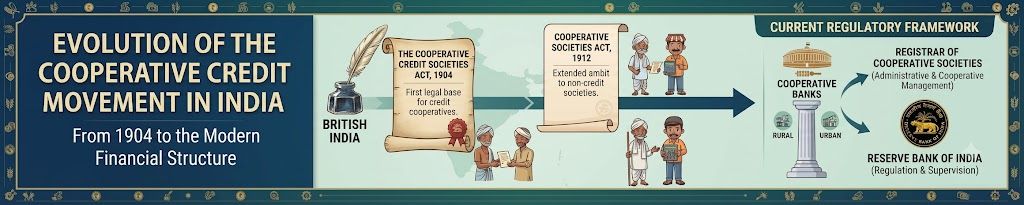
The cooperative banking movement eventually evolved into cooperative rural and urban banks. This banks now constitute an integral part of the financial structure of India. The Reserve Bank of India regulate and supervise the operations of the banks, while other administrative and cooperative aspects of these banks are managed by respective cooperative authorities.
Impact of the Great Depression
The economic depression of 1929-33 not only impacted the banking structure of various countries but also that of India. The banking structure of India was found to be flawed in this period, and many bank failures took place during this time frame. The Reserve Bank of India Act 1934 created the legal framework for the establishment of the Reserve Bank of India. The Reserve Bank of India started its work from 1 April 1935.
The establishment of the Reserve Bank of India was an important milestone in the history of Indian central banking, monetary policy, and banking regulations. It had some primary functions at the time of its inception.
Reserve Bank of India
Reserve Bank of India (RBI) is the central bank of India. The major functions performed by RBI are those related to monetary policy, regulation and supervision of banks, foreign exchange, currency, payments and settlements, and financial stability. The functions of RBI as the banker to the government and as the banker to banks are well-known. The RBI is the primary regulatory and supervisory authority for banks in its statutory jurisdiction in India.
Banking Regulation Act, 1949
After Independence, India's banking system needed a stronger legal and regulatory framework. The Banking Companies Act, 1949 was enacted to consolidate and amend the law relating to banking. This act was changed to the Banking Regulation Act, 1949 in 1966. The act provides an important legal framework for regulating banking companies in India. This includes licensing, management, banking business and the regulatory powers of the Reserve Bank of India. The act strengthened the RBI's regulatory role over the banking sector and became one of the key laws governing banking operations in India.
Bank Consolidation after Independence
Many poor banks were merged or liquidated in order to make the banks strong and stable. The Reserve Bank of India and the government undertook different initiatives in order to improve the stability of the banking institutions. The merger and growth of banking institutions resulted in the development of an organized and stable banking structure in India.
Nationalisation of Banks
A significant milestone in India's banking history was marked with the nationalisation of several major commercial banks. 14 Commercial banks were nationalised on 19th July 1969, with the objective of expanding banking facilities, increasing credit availability to agriculture and small industries, addressing regional imbalances, mobilizing savings, expanding credit to various sectors, and reducing the concentration of economic power. Expansion of priority sector lending emerged as an important goal of subsequent banking policy.
The 1969 nationalisation was initially achieved through the Banking Companies (Acquisition and Transfer of Undertakings) Ordinance, 1969, which was replaced by the Banking Companies (Acquisition and Transfer of Undertakings) Act, 1970. 6 more commercial banks were nationalised in 1980 under the Banking Companies (Acquisition and Transfer of Undertakings) Act, 1980. This resulted in India's major public-sector banking expansion.
Limitations and Problems of the Pre-Reform Banking System
A number of structural issues that emerged in the Indian banking system include: High incidence of directed lending, poor profitability, accumulation of non-performing assets, inefficiency, high statutory pre-emption, weak capital structure in some banks and lack of competition. Some other weaknesses observed in the Indian banking system include asset quality, poor financial performance and regulatory issues.
The emergence of these issues revealed the necessity for reforms in the banking sector of India during the 1990s. The process of reforms in this regard was largely guided by the recommendations of the Narasimham Committee reports in 1991 and 1998.
Banking Sector Reforms
The economic reforms that took place in 1991 witnessed some major reforms in the banking sector of India. These reforms were primarily directed at increasing efficiency, competition, capital adequacy, asset quality, transparency and prudence.

The recommendations made by the committee chaired by M Narasimham I in 1991 and the committee chaired by M Narasimham II in 1998 were responsible for the above-mentioned changes in the banking sector. Post 1990 reforms have seen the inclusion of prudential norms, deregulation of interest rates, increased competition and entry of new banks in the Indian economy.
In Short :
The journey of India’s banking system has been through continuous evolution and transition. It has witnessed the transition from traditional money lending to organised banking, beginning with the establishment of Presidency Banks, Imperial Bank and State Bank of India. The process of Indian-owned and cooperative banking saw further expansion of the banking network in the country. The establishment of the RBI in 1935 and the Banking Regulation Act, 1949 provided a strong regulatory framework to the Indian banking system. Nationalisation of the sector enabled an extensive outreach and institutional credit to the Indian economy.
However, banking witnessed a lot of challenges which led to reforms in the 1990s. In essence, it must be stated that Indian banking has seen a consistent effort at making the banking system more accessible, regulated, efficient and responsive to the changing needs of the Indian economy.
Login with