

Non-Banking Financial Companies (NBFCs) are companies that undertake specified financial functions, but they do not come under the purview of being banks as per the relevant regulations. The NBFCs, depending upon their classification, may give loans and undertake several other financial functions, thus playing a significant role within the financial sector.
The topics that will be discussed herein include the legal definition of NBFC, principal business test, the distinctions between banks and NBFCs, classifications of NBFCs, and the regulation and supervision of NBFCs.

What Means of NBFC
Clause (f) of section 45-I of Reserve Bank of India Act 1934 defines Non-Banking Financial Company. This definition includes any financial institution which is a company; a non-banking institution which is a company and the principal business of which consists of receiving deposits under any scheme or arrangement or making loans in any manner; and such other non-banking institutions or classes of institutions as may be specified by the Reserve Bank of India with the previous approval of the Central Government.
Section 45-I(c) of the Act defines “financial institution” and includes such financial activities as lending or financing, acquisition of shares, stocks, bonds, debentures or government and local-authority securities, leasing and hire-purchase, insurance business and chit business.

Certain activities also fall outside the definition of financial institutions if done in compliance with statutory conditions. These include agriculture, industrial undertaking, purchase or sale of goods other than securities, provision of services and immovable property activities. Thus, the NBFC category depends on the relevant statutory definitions and RBI instructions.
The Principal-Business Test
If financial operations of a business entity are considered as its primary business activities under the following circumstances:
1. More than 50% of the total assets of the company are financial assets.
2. Income generated from the financial assets is more than 50% of the gross income of the company.
The above test is popularly called the 50–50 test(50–50 Principal Business Test) for NBFCs. It must be noted that any company meeting both of the above requirements can very well be included in the category of NBFCs depending on relevant statutes and RBI guidelines. However, it is not necessarily the case that if a company meets the 50–50 test then it would be registered as an NBFC.
Financial Activities and Their Regulators
different categories of financial institutiion and the regulatory agencies that oversee such activities.
|
Financial institution |
Regulatory |
|
Banks, many NBFCs, payment systems, certain money-market instruments |
Reserve Bank of India (RBI) |
|
Venture capital funds / AIFs, merchant bankers, stockbrokers, mutual funds, collective investment schemes |
Securities and Exchange Board of India (SEBI) |
|
Insurance companies (life, general, health, reinsurance) and insurance intermediaries |
Insurance Regulatory and Development Authority of India (IRDAI) |
|
Pension funds and National Pension System (NPS) |
Pension Fund Regulatory and Development Authority (PFRDA) |
|
Nidhi companies and certain mutual benefit companies |
Ministry of Corporate Affairs (MCA), under the Companies Act framework |
|
Chit funds |
State Governments, under the Chit Funds Act, 1982 |
Shadow Banking
This is a generic term for financial intermediation activities which have functions that are like those typically carried out by banks, although they are undertaken outside the traditional banking sector. Terms which are frequently used in international regulatory forums for such financial intermediation activities are “Non-Bank Financial Intermediation (NBFI)” and “Market-Based Finance.”
NBFI activities have roles comparable to traditional bank borrowing, like giving credit and moving money, but have differences in terms of funding mechanisms and risks involved. Non-Bank Financial Intermediation can add more sources of credit and diversification in the financial system. However, NBFI activities also pose risks to financial stability when they are done in cases of leverage, mismatch of maturity and liquidity, connectedness and poor risk management.
Differences Between Banks and NBFCs

|
Difference Point |
Banks |
NBFCs |
|
Loan/Investment Facility |
Have the power to lend money and invest |
Also possess the power to lend and invest, depending on their scope of registration. |
|
Demand Deposits |
accept demand deposits (e.g., current and savings account deposits) |
not receive demand deposits like banks; can accept term/fixed deposits according to RBI guidelines |
|
Payment Mechanism |
integral part of the payment and settlement process (RTGS, NEFT, clearing, and so on). |
not part of the payment and settlement system |
|
Cheques |
it issuing cheques against their own accounts and providing cheque-based banking services to their customers |
not offer cheque-based transaction facilities |
|
Deposit Insurance Scheme |
All deposits which are eligible are covered by Deposit Insurance and Credit Guarantee Corporation (DICGC) |
not come under the ambit of DICGC deposit insurance |
|
Regulation System |
Regulated mainly by RBI through banking legislation like Banking Regulation Act, 1949 |
Regulated by RBI through NBFC specific regulations and guidelines under the RBI Act |
Residuary Non-Banking Companies (RNBC)
It a category of NBFC whose main activity was receiving deposits under an arrangement, scheme, or any other method except for the one that belonged to the defined classes such as investment company, asset finance company, or a loan company.
The RNBCs had to comply with certain RBI requirements regarding allocation of money received from depositors, holding of liquid assets, and prudential norms. According to the historical regulatory regime, RNBCs had to invest a certain percentage of their deposit liabilities in prescribed assets such as government securities, fixed deposits or certificates of deposit with scheduled commercial banks and some other approved assets.

Previous regulations also specified specific criteria relating to the period of deposits, interest, and security of depositors. In this way, the directions issued by the RBI made RNBCs different from other types of NBFCs.
Core Investment Companies (CIC)
CIC is an NBFC which primarily engages itself in investments in equity shares, preference shares, bonds, debentures, debt or loans of companies within its group. Under the present RBI Regulations, It should have not less than 90% of its net assets as investments in equity shares, preference shares, bonds, debentures, debt or loans of group companies. Not less than 60% of its net assets should be invested in equity shares of group companies and units of InvIT as sponsor, subject to appropriate conditions.
In general, a CIC is not allowed to deal in its investments in equity shares, bonds, debentures, debt or loans of group companies other than through block sale of securities for disinvestment. Moreover, the regulatory regulations have put some limitations on the financial activities to be undertaken by the CIC whereas few non-financial activities can be done subject to appropriate conditions. Apart from that, RBI Directions, 2025 have some other conditions as well.
e.g. Tata Sons Pvt. Ltd., Bajaj Holdings & Investment Ltd., Jaiprakash Associates Ltd.
Microfinance Institutions (NBFC-MFIs)
MFI are those NBFCs which do not take deposits from the public and offer loans in the form of microfinance to the poorer strata of society. These are unsecured loans offered to households falling within the income category specified under RBI regulations.
The present regime mandates that an NBFC-MFI should have a minimum of 75% of their total asset base utilized for microfinance loans. This was different from the previous requirement where at least 85% of net asset value had to consist of “qualifying assets.”
Further, the requirement regarding Minimum Net Owned Funds (NOF) has undergone changes.The minimum NOF is ₹10 crore. There is no separate minimum NOF requirement for the North Eastern Region. This will have to be fulfilled by March 31, 2027 following the glide path.
e.g. Bandhan Microfinance, SKS Microfinance, Ujjivan Microfinance
NBFC–Factors
NBFCs that deal mostly with the factoring business, which is a means of providing finance where companies get finance against their receivables. According to the present RBI guidelines, for a firm to qualify to register as an NBFC-Factor, its Net Owned Fund (NOF) must not be less than ₹10 crore.
The Principal Business Conditions are:
At least 50% of financial assets should be engaged in factoring business.
At least 50% of income should come from the factoring business.
Note : An NBFC-Factor registration is made according to Section 3 of the Factoring Regulation Act, 2011.
Mortgage Guarantee Companies
This companies that mainly indulge in mortgage guarantees on housing loans. Mortgage Guarantee refers to protection of the creditor entity against the losses incurred due to a covered housing loan under the terms and conditions of the mortgage guarantee.
According to the present RBI norms, an MGC shall be deemed as an entity that is mainly indulging in mortgage guarantee business if either 90% of the business turnover or 90% of the gross income of such MGC arises from the business of mortgage guarantee.
e.g. India Mortgage Guarantee Corporation Pvt. Ltd. (IMGC)
Note : MGCs must obtain a Certificate of Registration from the Reserve Bank of India, and have a minimum Net Owned Fund (NOF) of ₹100 crore.####
Non-Operative Financial Holding Companies (NOFHC)
This is a holding-company structure proposed for promoter groups seeking to establish certain new private sector banks. The shares of the banking company and other financial subsidiaries are held by the NOFHC in accordance with the regulatory requirements.
In case of the universal bank license under the regulator’s on-tap licensing policy, the creation of a Non-Operative Financial Holding Company is not mandatory if the promoter is an individual or a stand-alone promoting/converting entity without other group companies. However, the bank should be launched through an NOFHC if the promoter or promoting entity has other group companies apart from the universal bank.
The NOFHC model is meant to ring-fence the banking business from the rest of the promoter’s financial services business while enabling consolidated supervision of the banking, securities, insurance, and asset management companies by the Reserve Bank.
Miscellaneous Non-Banking Companies (MNBCs)
MNBCs constitute a historical classification of non-banking companies in respect of chit fund business. Chit funds are regulated by the Chit Funds Act, 1982, The State Governments are concerned with the responsibilities like registration and regulation of chit business operations under the relevant law.
The MNBCs have been under certain restrictions of RBI concerning acceptance of deposits. They have been barred from accepting any further public deposits. In terms of regulation, the deposits received from individuals who were not the shareholders were repayable at maturity and could not be renewed. Further, RBI has clarified that no further registrations are being made for the MNBCs.
Asset Reconstruction Companies (ARC)
It is a company that purchases financial assets from banks and other financial institutions, especially stressed or distressed assets, for the purposes of asset reconstruction and recovery.
ARCs are licensed under Section 3 of the Securitisation and Reconstruction of Financial Assets and Enforcement of Security Interest (SARFAESI) Act, 2002 by the Reserve Bank of India. The RBI regulatory framework regulates the operations of ARCs in respect of asset reconstruction and securitisation.
The regulatory framework for ARCs contains requirements relating to capital adequacy, acquisition and reconstruction of financial assets, realization plan, asset classification, income recognition and other prudential matters.
e.g. Asset Reconstruction Company (India) Ltd. (ARCIL), Phoenix ARC Pvt. Ltd., Edelweiss ARC Ltd.
Fintech Developments in the NBFC Sector
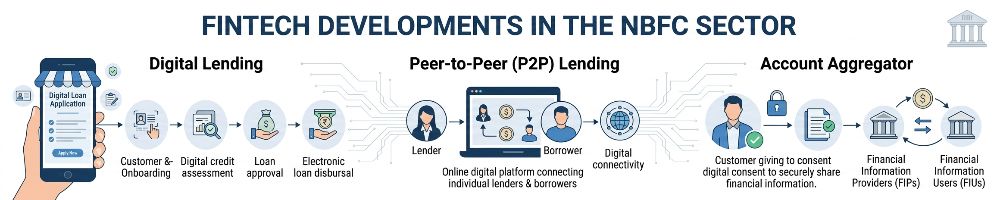
Digital Lending Platforms :
Digital lending platforms make use of technology for lending purposes that include loan application process, customer on-boarding, credit assessment, disbursal and management of loans. Any digital lending activities conducted by regulated entities are governed by the guidelines issued by RBI regarding transparency, consumer protection, data privacy and security, disclosures and outsourcing.
Peer-to-Peer Lending Platforms (P2P) :
P2P Platforms are lending facilities provided by the intermediary which enables the lenders and borrowers to transact business among each other through an online platform. In India, P2P lending facilities exist in the form of NBFC-P2P entities that are governed by Reserve Bank of India (RBI).
Account Aggregators :
This facilitate the transfer of specified financial information between Financial Information Providers (FIP) and Financial Information User (FIU). They enable the customers to share financial information electronically using consent framework.
Login with