
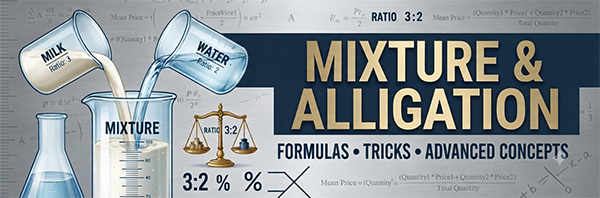
If you have attempted a problem involving milk and water, then you have come across mixture problems too. But mixture problems do not end at milk and water alone; they may include concepts like profit and loss, weighted averages, solution percentages, and transfers between vessels.
To tackle the problems, there are certain important principles that must be known. Some of them include weighted average principles, ratio techniques, alligation, and replacement. Understanding them will help you solve many mixture problems easily.
What Is a Mixture
A mixture refers to a combination of two or more substances. A homogeneous mixture is a mixture whose composition is the same in all parts. This implies that taking a sample of the mixture from any portion will yield the same composition.
Note : In case you take out some part of the homogeneous mixture, that taken-out part has the same ratio as that of the initial one. And in case you take out (without adding), the remaining mixture has the same ratio.
E.g.:
A 120 L mixture has spirit and water in the ratio 7:5.
Total parts = 12. One part = 10 L.
Spirit = 70 L, Water = 50 L.
If you remove 30 L, the remaining 90 L still has spirit:water = 7:5.
Removed part also has 7:5.
2. Adding One Component
When you add only one component (say water), the other component (say milk) stays the same. That unchanged component becomes your anchor.
Example: Add Water
A 90 L mixture has milk and water in the ratio 5:1. How much water must be added to make the ratio 10:3?
Initial: Milk = 75 L, Water = 15 L.
Milk stays 75 L.
Let added water = x.


Example: Add Milk
A 60 L mixture has milk:water = 3:2. How much milk must be added to make it 7:3?
Initial: Milk = 36 L, Water = 24 L.
Water stays 24 L.
Let added milk = x.


3. Vaporization and Evaporation
When water evaporates, only water reduces. The solute (sugar, salt, milk solids) remains unchanged.
Example:
A mixture has sugar and water in the ratio 7:11. When 36 L of water is vaporized, the quantities become equal. Find the initial quantity.
Sugar = 7 parts, Water = 11 parts.
After vaporization, water becomes 7 parts.
Water reduced by 4 parts = 36 L → 1 part = 9 L.
Total initial = 18 parts = 162 L.
4. Alligation: The Magic Cross
Alligation is a shortcut to find the ratio in which two ingredients must be mixed to get a desired mean value. It’s just weighted average in disguise.
Formula
Let cheaper value = x, dearer value = y, mean = z.

Diagram
text
Cheaper (x) Dearer (y)
\ /
\ /
Mean (z)
/ \
(y - z) (z - x)
Example 1: Milk Percentages
Mixture P has 30% milk, Mixture Q has 70% milk. What ratio should they be mixed to get 50% milk?

Example 2: Prices
Two types of sugar cost Rs.40/kg and Rs.60/kg. What ratio to mix to get a mixture worth Rs.48/kg?

Example 3: Profit and Adulteration
A milkman sells a milk-water mixture at Rs.6 per litre and earns a 50% profit. If pure milk costs Rs.8 per litre, find the milk:water ratio.
CP of mixture = SP / (1 + Profit%) = 6 / 1.5 = Rs.4.
Water costs Rs.0.
Alligation: Milk (8), Water (0), Mean (4).

Example 4: Averages
In a class, boys average 60 kg, girls average 40 kg, and the whole class averages 48 kg. If there are 50 students, how many boys?

Total parts = 5. 1 part = 10.
Boys = 2 × 10 = 20.
5. Multiple Replacement
This is where things get interesting. If you repeatedly remove a fixed fraction of a mixture and replace it with another component (usually water), the amount of the non-added component decreases exponentially.
Formula

where  = number of operations.
Example 1: Basic Replacement
A vessel has 100 L pure milk. 20 L is removed and replaced with water. This is done twice. How much milk is left?
Fraction removed = 20/100 = 1/5.

Example 2: Finding the Removed Quantity
72 L pure milk.  L is removed and replaced with water twice. Finally, water is 40 L. Find .
Final milk = 72 – 40 = 32 L.


Example 3: Wine Replacement
80 L pure wine. 25% is removed and replaced with water. Repeated 3 times. How much wine is left?
25% = 1/4.

Key tip: Always track the component that is never added.
6. Complex Multi-Vessel Problems
These problems involve several vessels, each with its own ratio, and sometimes transfer between vessels.
Example: Three Vessels
Vessels A, B, C have quantities in ratio 1:1:2.
A has milk:water = 2:1.
B has water:milk = 1:2 (so milk:water = 2:1).
C has milk:water = 3:1.
When all are mixed, milk exceeds water by 40 L. Find total quantity in A and B.
Let A = x, B = x, C = 2x.
A: M = 2x/3, W = x/3
B: M = 2x/3, W = x/3
C: M = 1.5x, W = 0.5x
Total M = 17x/6, Total W = 7x/6
Difference = 10x/6 = 5x/3 = 40 ⇒ x = 24.
A + B = 2x = 48 L.
Example: Transfer Between Jars
Jar A has 60 L milk:water = 5:1.
Jar B has milk:water = 3:2.
12 L from A is poured into B. Now the difference between milk and water in B is 18 L. Find initial milk in B.
12 L from A: Milk = 10 L, Water = 2 L.
Let B initially have milk = 3k, water = 2k.
After transfer: Milk = 3k + 10, Water = 2k + 2.
Difference = (3k+10) – (2k+2) = k + 8 = 18 ⇒ k = 10.
Initial milk in B = 3k = 30 L.
7. Miscellaneous Advanced Concepts
Replacement with Another Mixture
A 200 L mixture has acid:spirit = 3:5. 50 L is removed and replaced with a mixture having acid:spirit = 1:1. Find the final ratio.
Initial: Acid = 75, Spirit = 125.
Remove 50 L (3:5): Acid removed = 18.75, Spirit removed = 31.25.
Remaining: Acid = 56.25, Spirit = 93.75.
Add 50 L (1:1): Acid = 25, Spirit = 25.
Final: Acid = 81.25, Spirit = 118.75 = 13:19.
Chemical / Fertilizer Mixtures
AS fertilizer has N=20%, P=60%, K=20%.
AP fertilizer has only N and P.
A mixture of AS and AP has N=30%, P=65%, K=5%.
Find N:P in AP.
K comes only from AS.
0.20 × AS = 0.05 × Total ⇒ AS = Total/4, AP = 3/4 Total.
Let Total = 100. AS = 25, AP = 75.
N from AS = 5. Total N = 30 ⇒ N from AP = 25.
P from AS = 15. Total P = 65 ⇒ P from AP = 50.
N:P in AP = 25:50 = 1:2.
Multi-Level Mixing
Item K is made by mixing Chemical A and B in ratio 7:5.
Chemical A = X:Y = 2:5.
Chemical B = Y:Z = 3:2.
756 units of K are mixed with water so that Y concentration becomes 45%. How much water?
Y in A = 5/7. Y in B = 3/5.
K = A:B = 7:5.
Y in K = (7×5/7 + 5×3/5) / 12 = (5 + 3)/12 = 8/12 = 2/3.
Y in 756 units = 504.
Final concentration = 45% = 0.45.

Weighted Averages with Sections
Four sections A1, A2, A3, A4 have average marks 44%, 52%, 70%, 79%.
Overall average = 65%.
(A1+A2) average = 47%, (A2+A3) average = 65%.
Find A1:A4.
From (A1,A2)=47%:

From (A2,A3)=65%:

Combine: A1:A2:A3 = 25:15:39.
Let A4 = x. Overall average 65% gives:

Solving gives A1:A4 = 2:3.
8. Quick Recap & Formula Sheet
|
Concept |
Formula / Rule |
|
Homogeneous removal |
Ratio unchanged |
|
Add one component |
Other component unchanged |
|
Vaporization |
Solute unchanged |
|
Alligation |
Cheaper:Dearer = (Dearer–Mean):(Mean–Cheaper) |
|
Multiple replacement |
Final = Initial × (1 – Removed/Total)^n |
|
Profit/Loss |
CP = SP / (1 ± Profit/Loss%) |
|
Weighted average |
Avg = (n1A1 + n2A2 + …) / (n1+n2+…) |
|
Multi-vessel |
Write equations for each component, solve |
Final Words
Mixture and alligation problems look scary because they combine ratios, percentages, and equations. But they all boil down to a few ideas:
- Identify what doesn’t change (milk when adding water, solute when evaporating, etc.).
- Use alligation when two things are mixed to get a mean.
- Use the replacement formula when the same operation repeats.
- For complex problems, write equations for each component.
Practice with different numbers, and soon you’ll see the same patterns everywhere. Happy solving!
Login with