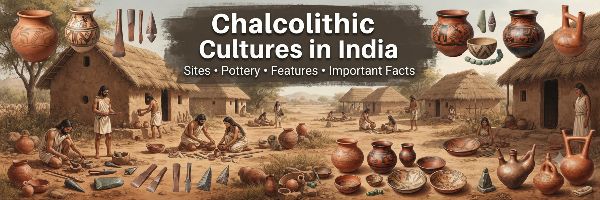
The Chalcolithic age is characterized by this period of development. In the regions such as Ahar-Banas and Kayatha, Malwa, Savalda and Jorwe, various cultures and pottery developed. Let us look at these cultures that have characterized the Chalcolithic age, their major sites
The Chalcolithic age, which is also known as the age of copper and stone, played a significant role in the evolution of agriculture and villages on the Indian subcontinent. Chalcolithic is made up of two Greek words, chalcos, which means copper, and lithos, which means stone. The use of copper in addition to stone tools occurred during this era. Agricultural pursuits, cattle rearing, making of pottery, crafts, and village settlements gained significance in various parts of India.
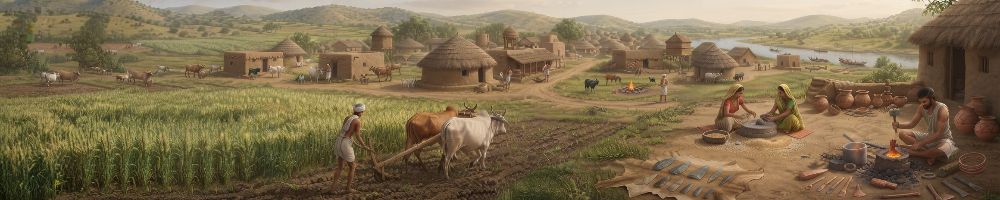
It is essential to realize that the Indian Chalcolithic period did not constitute a single unified culture of the same kind. Various regions had their own distinctive pottery, settlements, economic patterns, and materials. The important cultural regions of the Indian Chalcolithic age included Ahar-Banas, Kayatha, Malwa, Savalda, and Jorwe. Some Chalcolithic cultures existed at the same time as the Harappan Civilization, while other developed later. The main feature of the Chalcolithic period was the combined use of copper and stone technologies.
The most significant technological innovation that occurred during the Chalcolithic age involved the use of copper in combination with stone and not as a replacement for it. Copper was utilized in the manufacturing of tools, weapons, ornaments, and other items, but stone was still used extensively in the creation of blades, microliths, arrowheads, grinding stones, and other domestic implements. Availability and utilization of copper differed from place to place because of the difference in availability of copper deposits and local technological practices. Therefore, Chalcolithic age is considered to be an intermediate stage of technological evolution where both copper and stone technologies were practiced simultaneously.
Main characteristics of Chalcolithic societies:
- they were Use metal and stone tools,
- Settled agricultural societies ,
- Growing of grains, legumes, and other crops
- Domestication of cattle, sheep, goats, and pigs
- Pottery making
- Decorative paintings on pottery
- Hunting and fishing in some areas
- Exchanges of raw materials and artifacts between regions
The mentioned characteristics varied from region to region.
Major Chalcolithic Cultures of India:
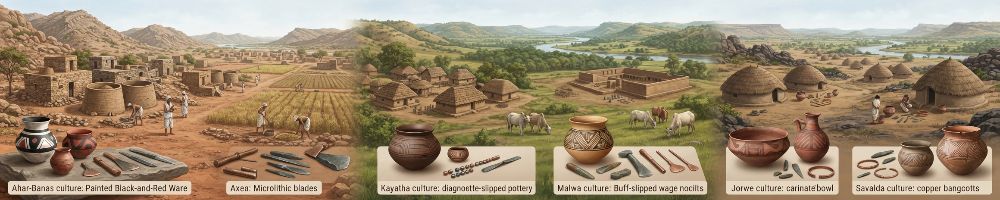
1. Ahar-Banas Culture
The Ahar-Banas Culture was a Chalcolithic culture in the southeastern part of Rajasthan. The culture emerged on the banks of the Banas, Berach and Ahar rivers. The Ahar-Banas Culture dates back to between 3000-1500 BCE and coexisted and was near to the Indus Civilization. Some significant examples of Ahar-Banas culture include Ahar, Gilund, Balathal, and Ojiyana. Over 90 sites belonging to Ahar-Banas Culture have been discovered, out of which majority are located along the valley of Banas River and its tributaries.
The Economy was mainly characterized by agriculture, animal rearing and exploitation of copper ores. The community practiced agriculture, growing crops like wheat and barley, while the presence of Aravalli hills gave them access to copper ores, which were raw materials used in the manufacture of implements. Pottery was yet another distinguishing feature of the Ahar culture. The pottery of Ahar is best known for Black-and-Red Ware with painted decorations that included geometrical, linear, and dotted motifs in white paint. Other forms of pottery include red, black, grey and buff wares.
2. Kayatha Culture
The Kayatha Culture was a significant Chalcolithic culture primarily linked to the Malwa region of modern day Madhya Pradesh. The type site for the Kayatha culture is Kayatha itself, which is situated in the Ujjain district and has yielded information about an early agricultural society. Copper artifacts, stone tools, pottery and other crafts items have been unearthed from the Kayatha site.
Agriculture and animal husbandry were an integral part of the economy of the people. Pottery from the Kayatha culture is notable for its Chocolate-slipped Ware, among others. The tradition of this culture is considered one of the important early Chalcolithic cultures of central India.
3. Malwa Culture
The Malwa Culture emerged primarily from the Malwa area of the modern state of Madhya Pradesh, as well as from other sites in the modern state of Maharashtra. The key sites belonging to Malwa cultures include Navdatoli, Maheshwar, Eran, Nagda, and Inamgaon. Navdatoli is one of the most important sites of the Malwa Culture, which is located on the banks of the river Narmada in Madhya Pradesh.
Malwa pottery is famous for its painted designs, which usually involve the buff or cream colour of the body with the painting in dark brown or black paint. The designs included geometric shapes, animal figures, bird and plant figures, and figures of humans. This characteristic pottery is one of the significant archaeological features of the Malwa Culture. Agricultural production was one of the key economic activities including cultivation of wheat, barley and various pulses.
4. Savalda Culture
This Culture is also an important early Chalcolithic culture and is primarily associated with the Tapti (Tapi) and Pravara valley regions of MaharashtraTapti (Tapi) and Pravara valley regions . Agricultural practices, cattle rearing, pottery, use of metal items made from copper, stone implements, and crafts can be seen in Savalda sites. Even after the advent of copper implements, stone tools were being used. One can see Black-on-Red ware pottery at Savalda sites.
5. Jorwe Culture
The one of the significant cultures of the Deccan Chalcolithic period, located especially in present-day Maharashtra. This culture has got its name from the Jorwe archaeological site. Early Jorwe is said to have existed in the period of 1400-1000 BC, while late Jorwe is believed to have existed from 1000-700 BC.
Some Important site of Jorwe culture include Jorwe, Inamgaon, Daimabad, Prakash and Walki. This culture occupied a large portion of Maharashtra and also some parts of Madhya Pradesh. Jorwe pottery is usually known as pottery of red or orange color and decorated with black designs, which made it very distinctive for the archaeologists. Their economy was based on agriculture and animal rearing. Crops cultivated were wheat, barley, legumes and millets, with millets gaining significance during the late phase of Jorwe culture.
Inamgaon is one of the key Jorwe sites where in the Deccan. This site is situated in Maharashtra.These include Malwa and Jorwe stages. Thus, Inamgaon becomes very significant for understanding the cultural evolution in the Deccan region.This sites is indicative of agricultural practices, domesticated animals, houses, pottery, copper artifacts, stone tools, and storehouses. This helps in getting an understanding of the economy and lifestyle of the community.
Chalcolithic Cultures and the Harappan Civilization
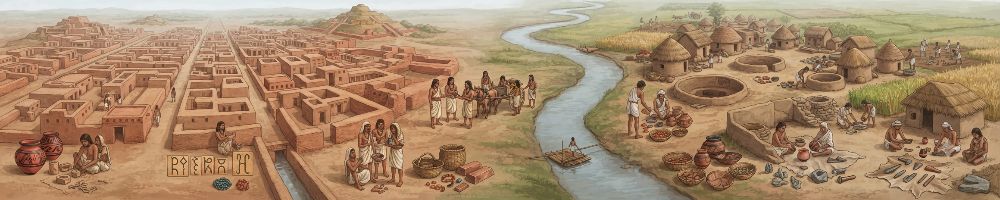
The Chalcolithic cultures of India and the Indus/Harappan Civilization were not a single cultural tradition despite partially existing in the same broad period and interacting in some regions. The Harappan Civilization was a large urban tradition centered in the Indus and adjoining regions, while cultures such as Ahar-Banas, Malwa, Savalda and Jorwe represented distinct regional Chalcolithic traditions. Archaeological evidence from sites such as Ahar-Banas settlements and Daimabad indicates contacts, exchanges and cultural interaction between different communities.
The Ahar-Banas Culture, centered in southeastern Rajasthan, developed close to the Harappan cultural sphere and was broadly contemporary with the Mature and Late Harappan phases. Thus, the Chalcolithic period should be understood as a diverse network of regional cultures, with some communities developing independently but maintaining contacts with the Harappan world.
Decline and Transformation
Chalcolithic cultures in India could not Ended simultaneously since they have their own chronology and culture and some of their settlements were abandoned whereas other settlements remained in existence or were transformed through time. For example, in Maharashtra, the Jorwe Culture succeeded in existing until the Early and Late Jorwe phases where the latter dates back to approximately 700 BCE.
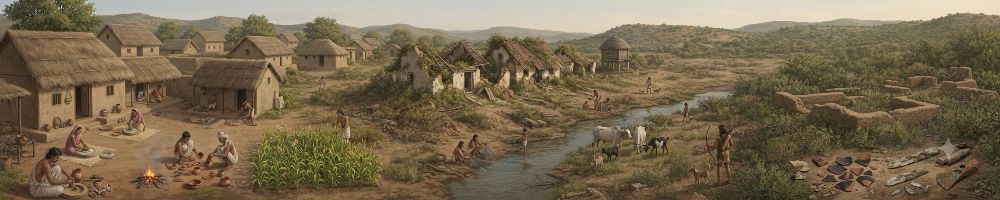
It has been established by archaeologists through excavations that there were changes in the settlement, housing and subsistence of the Early and Late Jorwe phases in Inamgaon. Farming is less significant during the latter phase as well as hunting and other means. Such factors as environmental deterioration, increasing aridity, change in rainfall and agriculture as well as other possible causes of change have been recognized by archaeologists as reasons of change but they are not considered common factors of change in all Chalcolithic cultures. Some of the settlements were abandoned and then new occupation occurred in some areas after a certain gap of time. Thus, the termination of Chalcolithic era has to be regarded as the gradual process of change and adaptation of regional cultures, not as the end of all Chalcolithic cultures.
Login with