Mastering Permutation & Combination: From Basics to Advanced (A Complete Guide)
Permutation and Combination (P&C) is often considered one of the most intimidating topics in quantitative aptitude. But here's a secret: it's not about memorizing endless formulas. It's about understanding a few core logical rules and knowing exactly when to apply them.
Based on a comprehensive breakdown of basic to advanced concepts, here is a complete, human-friendly guide to mastering P&C. I've replaced the standard textbook examples with fresh ones to help you understand the core logic without just memorizing answers.
Let’s dive in!
Part 1: The Foundation – Permutation (Arrangement)
What is Permutation?
Think of permutation as arranging items. The golden rule here is: Order Matters. If you change the position of an item, it creates a new arrangement.
- The Formula: If you have
 distinct items and you want to arrange
  of them, the formula is:
^nP_r = \frac{n!}{(n-r)!}
]
- Factorials: Remember that
 ,
,  ,
,  ,
,  ,
,  ,
,  , etc.
1. Simple Arrangements (All Letters Distinct)
If you have a word with distinct letters, the number of ways to arrange them is simply  .
.
- Example: How many ways can you arrange the letters of the word "PLANET"? It has 6 distinct letters. So,
 ways.
ways.
2. Arrangements with Repetition (Identical Objects)
If a word has repeating letters, you must divide the total factorial by the factorial of the frequency of each repeating letter.
- Formula:

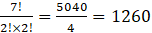
- Example: Arrange the letters of "BALLOON". Total letters = 7. L repeats twice, O repeats twice.
- Ways =
 .
.
3. Specific Position Constraints
Sometimes, you are asked to fix a letter in a specific spot.
- Example: Arrange "MONITOR" so that the middle position is occupied by 'T'.
- Logic: Fix 'T' in the middle. Now you have 6 remaining letters to arrange in the other 6 spots. Ways = .
4. "Begin and End" Constraints (The OR Rule)
When a word must begin and end with a vowel, break it into cases (Case 1: Begin with Vowel A, End with Vowel E; Case 2: Begin with E, End with A) and ADD them.
- Example: Arrange "DIALOGUE" (8 letters, vowels: I, A, O, U, E) so that it begins and ends with a vowel.
- Case 1: I _ _ _ _ _ _ E. Remaining 6 letters arranged in ways.
- Case 2: E _ _ _ _ _ _ I. Remaining 6 letters arranged in ways.
- Total:
 ways.
ways.
5. Vowels in Odd/Even Places
- Example: Arrange "COMPUTER" (8 letters, 3 vowels: O, U, E) such that vowels occupy only odd places.
- Logic: Odd places in an 8-letter word are 1, 3, 5, 7 (4 spots). We need to choose 3 spots for 3 vowels. This is a permutation problem:
 .
. - Arrange the remaining 5 consonants in the remaining 5 spots: .
- Total:
 ways.
ways.
Part 2: The Art of Selection – Combination
What is Combination?
Combination is about selecting a group. The golden rule here is: Order Does NOT Matter. Selecting (A, B) is the exact same thing as selecting (B, A).
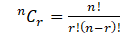
- The Formula:
- The Magic Property:
 . For example,
  . Use this to simplify calculations drastically!
1. The "AND" vs "OR" Rule
- AND (Multiply): If you must select 3 men AND 2 women, multiply the combinations.
- OR (Add): If you can select 2 red balls OR 2 green balls, add the combinations.
2. Team Formation & Handshakes
- Handshake Problem: If people shake hands with each other, the total handshakes =
 .
. - Example: 45 handshakes took place. How many people?
 .
. - Team Selection: How many ways to form a 5-person team from 5 men and 5 women? (No restrictions). Total people = 10. Ways =
 .
.
3. Conditional Selection (Always / Never / At Least)
- Always Included: If a specific person must be in the team, remove them from the total and the required selection.
- Example: Choose a 4-person committee from 10 people, but Person A must be included. We need 3 more people from the remaining 9. Ways =
 .
. - Never Included: If a specific person must NOT be in the team, remove them from the total.
- Example: Choose 4 from 10, Person A is excluded. Choose 4 from the remaining 9. Ways =
 .
. - At Least One: The golden rule is Total - None.
- Example: Choose 3 balls from 4 Red and 3 Green. At least 1 Red = Total (
 ) - No Red (
 ) =
) =  .
.
4. The Fruit Basket Concept
If you have  apples,
  mangoes, and
  oranges, and you can select any number of each (including zero), the total ways to select is:
- Example: 3 apples, 4 mangoes, 2 oranges. Total ways =
 . If selecting nothing is not allowed, subtract 1. Answer = 59.
Part 3: Number & Word Formation (Mixed Concepts)
This is where P&C meets basic arithmetic.
1. Repetition Allowed vs Not Allowed
- Repetition Allowed: If you have digits and places, total numbers =
 .
. - Example: 4-digit numbers from 1,2,3,4,5,6. Since repetition is allowed,
 .
. - Repetition Not Allowed: Use Permutations.
- Example: 4-digit numbers from 1,2,3,4,5,6.
 .
.
2. The "Zero" Constraint
If '0' is in your digit set, it cannot be the first digit.
- Example: Form 3-digit numbers from 0, 1, 2, 3, 4 without repetition.
- First digit has 4 choices (1, 2, 3, 4). Second digit has 4 choices (including 0). Third digit has 3 choices. Total =
 .
.
3. Even / Odd / Divisibility by 5
Always tackle the constraint first, usually the last digit.
- Even Numbers: Last digit must be 0, 2, 4, 6, 8.
- Divisible by 5: Last digit must be 0 or 5.
- Example: Form 3-digit even numbers from 1,2,3,4,5,6 without repetition. Last digit has 3 choices (2, 4, 6). The first two digits are filled from the remaining 5 digits:
 . Total =
  .
.
4. "Exactly One Digit" Problems
Break into separate cases based on the position of that specific digit.
- Example: 3-digit numbers with exactly one '7'.
- Case 1 (Last digit 7): First digit (8 choices, no 0), Middle (9 choices) =
 .
. - Case 2 (Middle digit 7): First digit (8 choices), Last digit (9 choices) = .
- Case 3 (First digit 7): Middle (9 choices), Last (9 choices) =
 .
. - Total =
 .
.
Part 4: Advanced Techniques (Mains Level)
1. The Gap Method (No Two Together)
This is essential for seating arrangements.
- Strategy: Arrange the unrestricted people first. Count the gaps. Place the restricted people in those gaps.
- Example: 5 men and 3 women sit in a row so that no two women sit together.
- Arrange 5 men: .
- Gaps created: _ M _ M _ M _ M _ M _ (6 gaps).
- Choose 3 gaps for 3 women and arrange them:
 .
. - Total =
 .
.
2. Alternating Arrangements
If boys and girls must sit alternately:
- If numbers are unequal (e.g., 4 boys, 3 girls), there is only ONE pattern: B G B G B G B.
- If numbers are equal (e.g., 4 boys, 4 girls), there are TWO patterns: B G B G B G B G OR G B G B G B G B.
- Multiply the factorial of both groups.
- Example: 4 boys, 4 girls.
 .
.
3. Circular Permutations
When people sit around a round table, rotations are considered identical.
- Formula:

- Example: 8 people around a round table.
 ways.
ways.
4. Geometric Counting
- Triangles: From non-collinear points, the number of triangles =
 .
. - Example: 10 points =
 .
. - Rectangles: If there are horizontal and vertical lines, the number of rectangles =
 .
. - Example: 8 horizontal and 10 vertical lines.
 .
.
5. Passwords, Locks, and Logic
- Letter Locks: If a lock has 3 rings, each with 10 letters. Total passwords =
 . Maximum unsuccessful attempts =
  .
. - Distribution: If you have 4 books and 2 students, each book can go to either student (2 choices). Total ways =
 .
. - Tournaments: If 6 matches are played and each can end in Win/Loss/Draw, total outcomes =
 .
.
⚠️ Common "Silly Mistakes" to Avoid
- Forgetting the '0' Rule: Always check if 0 is in the digit set. It cannot occupy the first position.
- Confusing "At Least" with "Exactly": "At least 1" means 1, 2, 3... (Use Total - None). "Exactly 1" means only 1 (Use specific casework).
- Forgetting Internal Arrangements: When you club items together (e.g., "All boys sit together"), don't forget to arrange the items inside the club.
- "Not Together" Trap: Remember, "Not Together" = Total Arrangements - "Together" Arrangements.
- Order of Operations: When solving number formation, always fix the most restrictive constraint first (e.g., the last digit for even numbers, the first digit if '0' is involved).
Mastering P&C is all about practice. The more you expose yourself to different constraints, the faster you'll recognize which formula or method to apply. Happy calculating!
Login with